
October 9, 2026
Metsä Tissue has deep roots in Nordic paper making, with a history spanning decades. Today it operates nine mills across five European countries—Finland, Sweden, Germany, Poland, and Slovakia—with a total tissue capacity of approximately 630,000 metric tpy and around 2,400 employees. It also produces greaseproof papers with a capacity of 60,000 metric tpy.
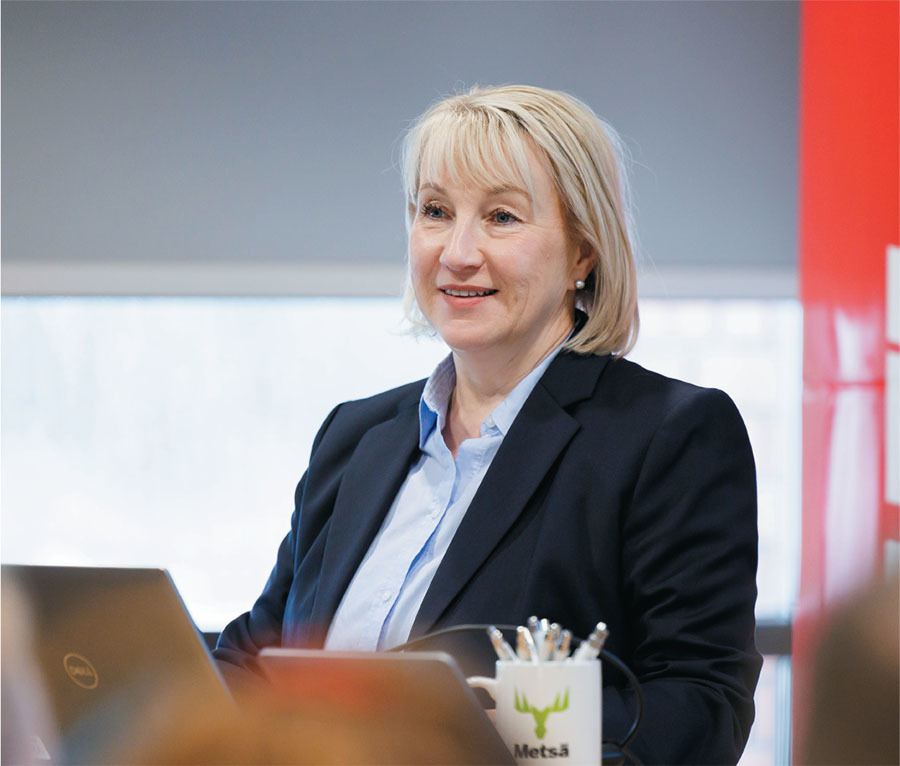 The company is one of the leading tissue manufacturers in Northern and Central Europe, with a strong position in both consumer and professional markets. Brands—Lambi, Katrin, Serla, Tento, and Mola—are well established across key markets. For greaseproof baking and cooking papers, it is one of the leading producers globally, serving a global market delivering to 80 countries.
As part of Metsä Group, the company has direct access to some of the most sustainably managed forests and pulp production in the world. That integration from forest to finished product is a major advantage in the market.
TISSUE360°: Can you talk about the products Metsä Tissue produces for the tissue market?
Pajari-Sederholm: We produce the full range of tissue products—toilet tissue, kitchen towels, facial tissues, napkins, and hand towels—for both consumer and professional markets. On the consumer side, our brands serve retail customers across Northern and Central Europe, ranging from premium products to everyday essentials. On the professional side, our Katrin brand is a complete hygiene solution for washrooms, kitchens, and food service environments, combining products with dispensing systems and service. What is increasingly important to us is moving beyond product to value; helping our customers grow their categories, meet their sustainability commitments, and serve their own end users better. That shift from product supplier to genuine partner is central to our strategy.
Can you tell us about the market in general for Metsä Tissue products and what challenges and opportunities are being presented?
The European tissue market is consolidating at both the customer and supplier level. Our retail customers are becoming fewer and larger, with higher expectations around scale, service, sustainability credentials, and category insight. At the same time, competitors have been investing in capacity aggressively. We lost some ground during a period when others were moving faster. That is precisely why we have now launched our growth strategy—to rebuild our competitive position from a stronger operational and commercial base. The opportunity is real: demand for quality tissue products remains stable, sustainability requirements are creating differentiation opportunities for producers with strong environmental credentials, and the professional hygiene market continues to grow as hygiene standards rise across Europe. We are well positioned to capture that growth.
Looking forward, how do you see the tissue market developing into the future in terms of products?
The direction of travel is clear: consumers and customers want products that perform well and can be made and used sustainably. Premium segments continue to grow, and sustainability is shifting from a nice-to-have to a procurement requirement, particularly in the professional segment. Our R&D focus is on optimizing what we do with the raw materials we have—primarily fresh, sustainably sourced Nordic fiber—and on reducing the environmental footprint of the production process itself. In greaseproof papers our new product, FreshPack, is one example of innovation we are actively developing—a packaging material aimed at eliminating plastic from food packaging. We are testing it on the market and refining it based on real-world experience. More broadly, we see the biggest opportunities in combining product quality with verified environmental performance data—something our customers can use directly in their own reporting and communication.
Can you tell us about how Metsä Tissue is dealing with the energy challenges in Europe currently?
Energy costs have been one of the defining challenges for European manufacturing over the past few years, and tissue production is energy intensive. Our response has been twofold. First, we have been systematically working to improve energy efficiency across our mills, reducing consumption per metric ton of product through operational improvements and targeted investments. Second, being part of Metsä Group also helps. Our access to bioenergy and integrated energy solutions within the group gives us options that standalone tissue producers do not have.
After the start-up of the renewed Mariestad mill in Sweden, are there any further expansion plans at Metsä Tissue? Is the planned UK mill now on hold completely?
Mariestad is a landmark investment for us—EUR370 million, 145,000 metric tons of capacity, built to be Europe’s most modern tissue facility. It is now operational and performing well. We remain committed to the UK as an important market for Metsä Tissue.
Can you tell us what difference the renewed Mariestad mill will make to Metsä Tissue?
Mariestad’s new line gives us modern, efficient, large-scale capacity in the heart of our Scandinavian market, producing from 80 percent fresh fiber with significantly lower environmental impact than older facilities. It also demonstrates to our customers, our people, and the market that Metsä Tissue is serious about its future. A EUR370 million investment is a statement of intent. Operationally, it raises the bar for efficiency and quality across our whole network. When you have a world-class benchmark inside your own organization, it drives improvement everywhere.
Any planned acquisitions in the future?
We, as all businesses, are working continuously on different growth scenarios. Our strategic direction is clear: we have an ambition to grow.
Can you talk about the technology Metsä Tissue prefers when it comes to tissue machines?
Our preference is for technology that delivers consistent quality at high efficiency with the lowest possible environmental footprint. Mariestad is the clearest expression of that—a state-of-the-art facility built around the most modern tissue machine technology available. Across our broader network, we are continuously assessing where investment in machine technology delivers the best return in terms of quality, efficiency, and environmental performance. We are technology-agnostic in the sense that we follow performance data rather than supplier brand loyalty. What matters is what the technology delivers for our customers and our cost base.
Can you tell us about Metsä Tissue’s approach to new technology in tissue, for instance, digitalization and AI?
This is an area where we are actively investing and where I see significant opportunity. We have a partnership with Qutwo focused on AI-powered optimization of our production—using machine learning to improve productivity, reduce waste, and improve end-product quality. Predictive maintenance, process optimization, improving and maintaining high end-product quality, customer service, supply chain planning, and reliability—these are all areas where data and AI are already changing what is possible, and we want to be at the front of that curve. The key principle we have adopted is simple: no AI project without a real business problem. That discipline is what turns technology investment into actual customer value.
Any plans at all to look at TAD technology in the future?
TAD produces an excellent product in terms of softness and bulk, but it comes with a significant energy cost, which sits in tension with both our environmental targets and our cost competitiveness agenda. We keep a close eye on developments in this space, including advances that are reducing the energy penalty of TAD and TAD-adjacent technologies. For now, our investment focus is on getting the best possible performance from our existing technology base while we build toward our growth targets. We will not rule anything out for the longer term.
Can you tell us about your converting areas and the technology involved?
Converting is where raw material becomes the product the customer and consumer actually experience, and it is more complex than it might appear from the outside. Our lines cut, fold, emboss, roll, and pack with high precision at high speed, and the quality of that process directly affects product quality and production cost. We have been investing in converting optimization, including the AI partnership with Qutwo I mentioned, precisely because we see significant efficiency and quality headroom there. The new hand towel line in Mänttä is a good example of how converting investment directly serves a market opportunity—in this case, meeting demand for Finnish-made, fresh-fiber hand towels.
Are suppliers providing the right type of technology for Metsä Tissue needs?
Our supplier relationships are important to us, and we work closely with our key technology partners. What we need from suppliers is the same thing we ask of ourselves: a genuine understanding of our business challenges, not just a product catalogue. The best supplier relationships are the ones where the supplier understands our quality targets, our cost constraints, and our environmental commitments and brings solutions that address all three together. We also increasingly expect our suppliers to support us on sustainability, both in terms of the environmental performance of their equipment and in their own supply chain practices. Partnership, not just transaction, is what we are looking for.
Anything special to talk about regarding internal and external logistics at your mills?
Logistics is a competitive dimension that does not always get the attention it deserves in the tissue industry. For us, operating a pan-European network across nine mills means that supply chain optimization—getting the right product to the right customer from the right mill at the right cost—is a source of genuine competitive advantage. Our pan-European organization gives us the structural foundation to optimize across the whole network rather than sub-optimizing mill by mill. Externally, we work closely with logistics partners and within Metsä Group on maritime and road transport tenders. Delivery reliability is one of the things our customers most consistently tell us they value, so logistics is not a back-office function for us, it is part of the customer proposition.
How important is sustainable production to Metsä Tissue?
Very important. We are part of Metsä Group, which controls its own forest and pulp value chain. That means we start with a raw material advantage that most tissue producers do not have. Our wood comes from sustainably managed Nordic forests and our pulp is produced with a carbon footprint significantly below the global average. But sustainability for us is not just about meeting regulatory requirements or responding to customer pressure; it is about building a business that is genuinely viable for the long term. We believe that a tissue company that cannot demonstrate its environmental credentials will not have a place in the European market of 2030.
Can you tell us what moves Metsä Tissue has made on the environmental front—lowering carbon footprint, raw material consumption, water use, etc?
We have made substantial progress across all these dimensions. For example, our pulp comes from Metsä Fibre’s Äänekoski bioproduct mill, which produces pulp with a carbon footprint at least 30 percent below the European and Latin American average. We have product-level CO2 footprint data available, third-party verified, which our professional customers can use directly in their own sustainability reporting and procurement processes. We hold a EcoVadis Platinum rating, which reflects performance across environmental, social, and governance dimensions.
Can you talk about Metsä Tissue’s approach to people and skilled employees?
We operate in the bio-industry, and that gives us a purpose story that resonates, especially with a younger generation that wants their work to mean something. Our culture is rooted in Scandinavian values: direct communication, low hierarchy, respect for the individual. People who have worked in more bureaucratic environments tend to find it refreshing.
And being part of Metsä Group, we can offer career opportunities across an integrated forest industry group spanning timber, pulp, board, and tissue. That breadth is something a standalone tissue company simply cannot match. The challenge is that manufacturing is not always the first choice for the talent we want. Changing that perception is part of our work.
Do you have any challenges in obtaining skilled employees? If so, what is your approach to solving the challenges?
There is some competition for skilled people in manufacturing in Europe, and we are not immune to it. Our approach is to be genuinely attractive as an employer, which means offering real development opportunities, a clear sense of purpose, and the stability of a well-capitalized business with investment going into its sites.
PHOTOS: METSÄ GROUP
Key Facts and Figures from the Mariestad Expansion
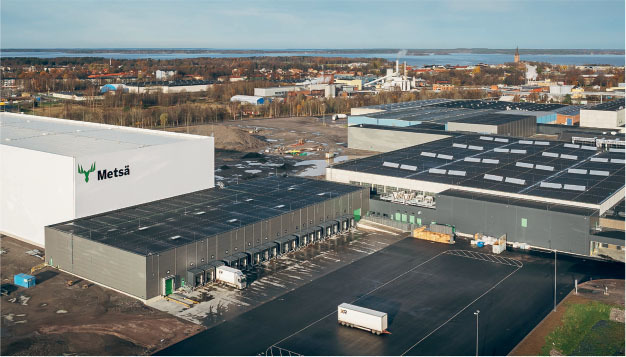
- EUR370 million investment
- 145,000 metric tpy production capacity
- New tissue machine, bringing the total number of paper machines at the mill to three
- Three new converting lines for both rolled and folded tissue products, bringing the total number of converting lines to nine
- Fully automated high-bay warehouse
- New dispatch area
- New office building
__________________________________________________________________________________________________________
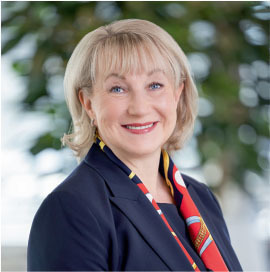
Sari Pajari-Sederholm has spent most of her career in the forest industry, in roles spanning operations, strategy, business development, and general management. She joined Metsä Tissue as CEO with a clear mandate: to lead the company through a significant strategic transformation. Her background is rooted in understanding how industrial businesses create value—from the mill floor to the customer relationship—and that perspective shapes how she thinks about leading Metsä Tissue. Pajari-Sederholm comments: ”