
October 8, 2026
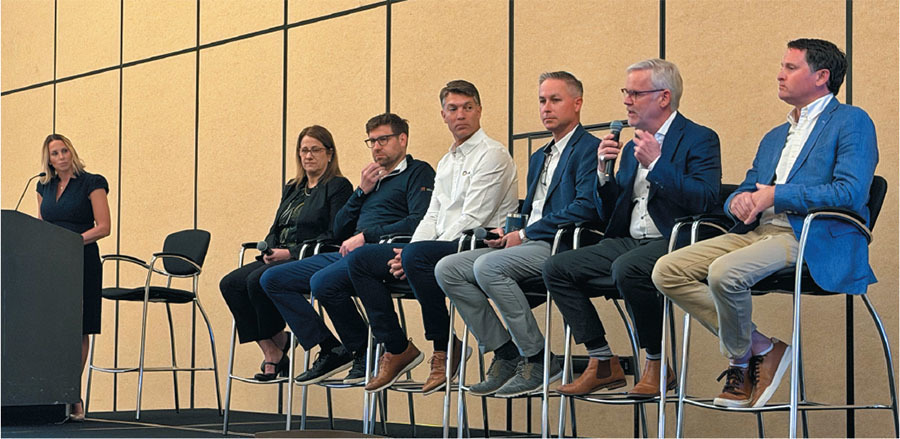
At AICC’s recent Spring Meeting in Calabasas, CA, “AI” was the buzzword for independent corrugators. Wednesday’s tech-forward breakout session, titled AI in ERP & Plant Management Systems, was a highlight.
This panel-style presentation explored how AI is transforming ERP and plant management systems in box plants. Panelists discussed the ways AI technologies—such as machine learning, predictive analytics, natural language processing, and intelligent automation—can offer box plants a host of benefits when embedded into the familiar plant management solutions already necessary to run plants of any size. Tonya Morelli, COO of The Morelli Group, moderated a panel that included:
- Danna Nelson, Amtech Software
- Scott Anderson, Kiwiplan, an Advantive Company
- Dave Hall, ePS
- Jason Hooston, Two10 Technologies
- Peter Dobell, OMP
- Philip Webb, Pakked
BOTTLENECK ‘BUDDY’
The group started by addressing a common question posed by many professionals who are not yet using AI: Can it be trusted? The answer is yes…and no.
The truth depends on the scope and purpose of its use, as well as the user’s facility with the technology. The saying “always keep the human in the loop” is well applied, for new users especially. Dobell noted that all data can be “messy,” whether from a human or AI. He thinks of AI not as a source of all answers but more as a “buddy”—an asset to consult, even though it may not always be right.
As Anderson pointed out, the corrugated industry already had programs that could tell plant managers what happened; AI can help them understand why it happened. “(AI) can tell you exactly where to look to help you minimize waste,” he said. “Look at an area where you have a bottleneck and apply AI. Ask, ‘how can I get this information more quickly?’”
It can be especially useful to direct AI capabilities to repetitive tasks within the process (such as data gathering, verifying information, etc.) to free up staff time, Anderson added. As he told AICC meeting attendees, “One benefit that you all have (as independent corrugators) is that you can ‘touch’ the customer. AI can help you take care of those repetitive tasks so that your people can maintain that human connection with your customers. That’s an advantage that you have that bigger companies don’t always have.”
Corrugated plants are likely to use agentic AI rather than generative AI; that is, they want technology that can help them with process planning, task execution, and system coordination to optimize plants and resolve customer issues. An example of this, said Hooston, is that AI can seek out data validation errors. “Is it expensive? Absolutely…but can AI have an effect on the bottom line? Absolutely,” he said.
“AI can help push information to your sales team, almost before they ask for it,” added Webb. “(With AI embedded into the system) we can remove the bottlenecks that are causing delays to the customer. Once we have that front end information put together, it goes straight to the production floor. The future is about speed; we just launched the first AI that can allow you to quote in minutes, not days.”
WHERE TO START
As a software supplier for the packaging industry, Hall said there is one question customers always ask about AI: “Where do we start?”
“It’s important that you begin by setting a direction,” he advised. “Give your people a little leeway, let them be creative, but also give them boundaries. For instance, you could tell your team, ‘I want to reduce cost.’ After you get past that first 90 days, we come in and scale up.”
Hall offered attendees a tip to get employees comfortable with the idea of AI. “Get a $100 gift card and start a contest: The gift card goes to the employee who can use AI to come up with the idea that most helps the company.”
Anderson recommends that box plants start by building AI into the process; encourage staff to use it every day to increase their comfort level and share ideas. Yet there was one thing he warned against. “Don’t just sign up for the free version. Sign up for the enterprise level,” Anderson said. The reason? “You don’t want that free version using or learning from YOUR pricing structure, or your processes, as the model. You don’t want your competitors to learn from that as they begin to use AI, too.”
Hooston seconded that warning—and took it one step further. “Yes, it must be a company-wide engagement; you don’t want it to be only a few employees using AI,” he said. “But the power of AI really comes into play when you can get your data consolidated into one program, so that AI can reach it all. You do not want to create information silos in your plant.”
These initial forays into AI use may seem “scary,” says Webb, but they are coming. He offered a tip for increasing the value of the time spent. “First, get your data organized,” he recommended. “Then we can design agentic AI to give your customers what they want. If we have silos of data, customer questions can go to the wrong place; when data is organized, the AI agent gets that answer right away.”
OPPORTUNITY—OR RISK?
As moderator, Morelli posed a question on the minds of many attendees: How concerned should the panelists’ customers (i.e., independent corrugated companies) be about the risk of their proprietary information being shared through AI?
“A lot of people get hung up—and rightly so—about their company-specific information getting ‘out there.’ It’s incredibly important that you don’t use public AI for sensitive information,” advised Hall. “It’s important to use the right security models. If you ask Claude or ChatGPT a question, (you’ll receive) an answer based on everything that Claude knows, or that ChatGPT knows.
“AI engines are leapfrogging each other. You need to get into the habit of staying current. If you’re running a software that’s a year old…yes, it may be a security risk. But it’s definitely an enterprise risk if you’re not using AI to get ahead,” Hall said.
Nelson suggested that a company’s IT specialist should lock employee access to public AI forums; he has heard cautionary tales of employees inadvertently loading private data into public forums.
USE CASES
Once safety concerns are addressed, users can begin to decide where AI can have the most benefit for their plants. “ERP systems are really good at transactions—to ‘run the business.’ It can tell you who bought something, what they bought, where it went, etc. But that’s transactional data,” Nelson said. “AI is where you can start looking at that data.
“How do we (as vendors) bring that value to your plant?,” he asked attendees. “What will that mean for your operators? For your business? You’re going to see ERP companies, and every software company in the world, trying to figure out the ‘use cases’ for AI—how it will bring value to YOUR business. We can start by taking a specific goal of your company and bring together all the relevant data to achieve that goal.”
According to Dobell, most corrugated plants are already generating the data they need to be more proactive. “AI can point you toward it. For instance, you may have a customer that orders the same order, regularly, around the same time. AI can recognize that,” he said. “You can call that customer and say, ‘You know, you usually order this box by now, can we get that put in for you?’ That’s an example of how AI allows you to be more proactive.”
Added Anderson, “You can definitely train AI to give you the information that you need. But you can also get information that you’re not thinking to ask. AI capabilities are additive, not static. You want the AI ideas to evolve as your business evolves.”
________________________________________________________________________________________________________________________________________________
Where to Grow Your Human Intelligence
This article covers only a fraction of the information and engagement available from a recent industry event. It’s exciting to hear how AI modules can learn—yet it’s important to remember that YOU can learn, too.
Check out these forthcoming events designed just for corrugators and packaging professionals. Nothing beats the energy, networking, and knowledge exchange that can take place between live humans. That’s a different kind of AI—”Acquired Intelligence”—that will also help your mill or plant run its best.
SEPTEMBER 2026
TAPPI/AICC Corrugated Week
Sep. 28-30 | Fort Worth, TX
www.corrugatedweek.org
NOVEMBER 2026
Forest Products NA and Int’l Containerboard Conference
Nov. 2-4 | Chicago, IL
fastmarkets.com
APRIL 2027
AICC Spring Meeting
Apr. 5-4 | Doral, FL
aiccbox.org
SEPTEMBER 2027
TAPPI CorrExpo®
Sep. 27-29 | Cincinnati, OH
www.correxpo.org