
October 8, 2026
It was an overall positive atmosphere among the keynote speakers at the Pulp & Beyond conference, despite yet another ongoing challenge presented to industries across the world in the shape of the Iran war. Perhaps all of us in industry have adapted to constant uncertainty as the permanent normal.
Tuuli Koivu, chief economist at Nordea, kicked off the proceedings in Helsinki with a presentation focused on the direction of the world economy in an uncertain world. In an upbeat presentation, Koivu said that global growth, despite all the headwinds, is proving to be resilient at around three percent, and this should continue despite the ongoing challenges. She commented that perhaps global industry has learned to navigate major challenges due to the pandemic earlier in the decade.
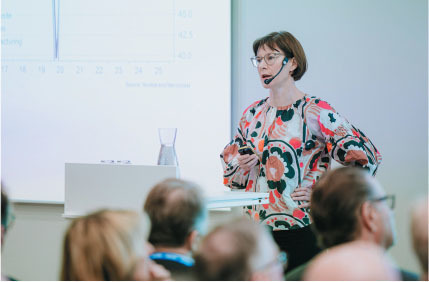
Tuuli Koivu, chief economist for Nordea.
However, Koivu warned that European industries have some catching up to do as the US streaks ahead on its labor productivity. “New technologies have the answer to enable other nations to improve,” she said.
Presumably that answer lies with AI. The second keynote at the conference was presented by Antti Vasara, a partner with Kvanted, a Helsinki-based venture capital firm specializing in industrial technology. Vasara tackled the burgeoning subject of AI, stating that adoption of the technology is more about being competitive than simply IT savvy.
To stay ahead of the competition—namely, the US—European companies need to instruct AI on what the actual goals are and let it decide how to get there. Vasara said that the technologies are already out there, and companies should implement AI in predictive maintenance, process optimization, and knowledge capture—as soon as possible.
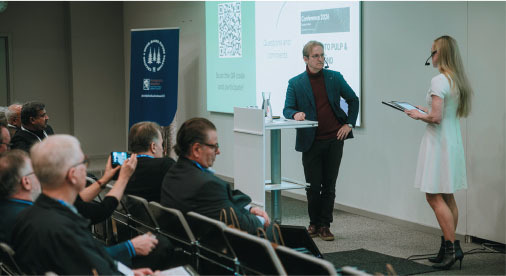
The third keynote was given by Wilhelm Wolff, executive vice president, strategy for Metsä Group, who talked about how the group is balancing sustainability and competitiveness in Europe after completing major pulp mill investments in Finland, including the Kemi and Äänekoski projects. Wolff said, “Metsä Group is shifting its strategic focus toward greater resilience and gradual expansion in converting, packaging, and wood construction materials, as well as a large tissue expansion in Sweden.”
With globally competitive assets now in place, Metsä Group is prioritizing steady growth while advancing sustainability goals.
As usual, the Pulp & Beyond organizers set up a press tour led by industry marketing veteran Teppo Koski. Editors and journalists were treated to various meetings and visits around Helsinki and beyond to learn more about the innovations taking place with producers and suppliers to the industry. You can read more about the press tour in the coming pages of Paper360° and Tissue360°.
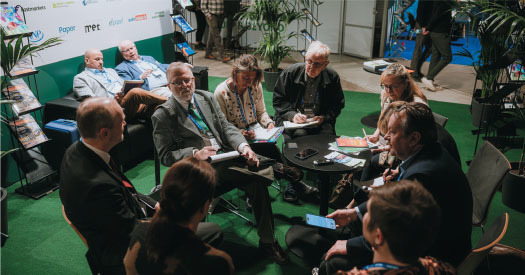
SPOTLIGHT ON PRODUCERS
Metsä Group: Metsä Group’s sales reached EUR 5.8 billon (US$6.7 billion) in 2025, with market pulp accounting for the largest share. The group also produces tissue, board, and greaseproof paper, as well as solid wood for construction.
It is probably best known for its approach to innovation at its bioproduct mills across Finland. Wolff hot-footed it from his task as keynote speaker at the event to join the industry press gathering. He spoke to the press about the group’s flagship initiative: A commercial-scale biogenic CO2 capture project targeting 100 kilotons annually at the group’s Rauma mill in Finland.
The captured CO2 will be sold to partners for conversion into renewable fuels such as marine fuels, methane, and methanol. Metsä views the project as both a profitable business opportunity and a way to gain valuable operational experience that could accelerate Europe’s renewable fuel sector. The company remains committed to its fossil-free target by 2030, though it is advancing cautiously to protect competitiveness.
In terms of further major investments, Wolff said, “In these difficult times, the biggest challenge is deciding on investments; we are fortunate that our major investments are now finalized so we don’t have a huge need for more projects—it’s a good place to be.”
Also speaking to the press was Sari Pajari-Sederholm, CEO of Metsä Tissue, who emphasized tissue’s critical role in public hygiene and European supply security. The company operates nine mills across Europe, generating roughly EUR1 billion (US$1.6 billion) in turnover. With 99 percent of European tissue consumed locally, production remains strongly regional due to high transport costs.
Pajari-Sederholm highlighted a strategic shift from recycled to fresh fiber for hygiene products: “Declining quality and availability of recycled fiber, linked to fewer printed magazines, make fresh northern softwood fiber the more sustainable and reliable choice for high-quality tissue, despite regulatory pressure for recycled content.”
Metsä Tissue recently inaugurated its expanded and modernized tissue mill in Mariestad, Sweden. The EUR370 million (more than $US430 million) investment is one of the largest in the European tissue industry and reflects Metsä Tissue’s commitment to the future of the European hygiene and tissue sector.
The renewed Mariestad mill has doubled its annual production capacity to approximately 145,000 metric tpy, strengthening the availability of high-quality tissue products in Scandinavia. Pajari-Sederholm said, “By strengthening local production, we improve availability, reduce supply chain risks, and support our customers across Scandinavia—strengthening Metsä Tissue’s position as a trusted long-term partner to its customers.”
____________________________________________________________________________________________________________
UPM: “UPM is transforming from a traditional pulp and paper company into a diversified material solutions leader,” said Kati Kaskeala, UPM Fibres’ vice president of marketing, sustainability, and communications. “We are leveraging renewable resources and sustainability as core strengths.”
The company’s business portfolio spans four areas: Communication Papers (with a potential joint venture with Sappi pending approval), Renewable Fibers (pulp and sawmilling), Advanced Materials (specialty papers and adhesives), and Decarbonization Solutions (biochemicals and biofuels).
Major recent investments include the Paso de los Toros pulp mill in Uruguay—the company’s largest-ever investment—which reached full 2.1 million metric tpy capacity in 2023; and the world-first wood-based biochemicals facility in Leuna, Germany. Last year’s sales reached EUR9.7 billion (about US$11.3 billion.)
UPM Fibers’ pulp business stands as the world’s leading multi-fiber producer, with 5.8 million metric tpy annual capacity from mills in Finland (Jyväskylä, Kymi, and Rauma) and Uruguay (Fray Bentos and Paso de los Toros.) It uniquely offers eucalyptus, Nordic softwood, and birch pulps. All production is sold as market pulp.
UPM maintains 100 percent FSC and PEFC certification, zero deforestation, full traceability, and no GMOs. It owns more than 500,000 hectares of Finnish forests and significant plantations in Uruguay, with more than 70,000 hectares dedicated to conservation.
The Paso de los Toros start-up has made UPM the second-largest eucalyptus supplier in North America, with more than 10 percent market share at 350,000 metric tpy. “The sustainability factors at Paso de los Toros in Uruguay are particularly outstanding,” said Kaskeala. “Only 60 percent of our plantation land is used for commercial purposes; the remainder is set aside for cattle grazing and beekeeping. Over 200 beekeepers operate within the plantations. We also supply six percent of all the electricity required for the country.”
Kaskeala added that more than 95 percent of fuels used in pulp production across its mills are bio-based, minimizing fossil fuel reliance. Furthermore, with operations focused on circularity, the company is on track for its mission to send zero waste to landfill by 2030.
“We are now totally focused on performance and growth from existing assets,” concluded Kaskeala. “UPM continues driving innovation in renewable materials while strengthening its position as a preferred, sustainable supplier globally.”
UPM is headquartered in Finland and publicly listed, employs 15,000 people across 48 production plants in 10 countries, and operates in 42 nations, reaching approximately 300 million end users worldwide.