
February 10, 2026
Piping and Instrumentation Diagrams (P&ID) are foundational documents that give engineering, operations, and maintenance staff insight into the elements, interconnections, and relationships a system may have. As with any architectural type of diagram, they have a language of their own.
Often, the contractor who built the system will provide P&ID as part of their “as-built,” package. How consistent they are with reality is always a question worth asking.
It is a good idea to verify P&ID against what is out on the production floor or in the walls. They will be close, but you will always find opportunities for a redline to adjust the drawing. Most likely your company has an official process to get these changes made.
Location, location, location
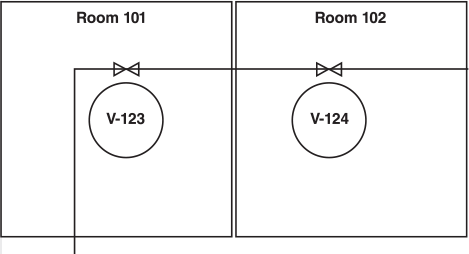
If you take a drone view of a P&ID, you may find lines of distinction that define the rooms, floors, and areas where the various components of the system reside. In the example here, we find that V-123 (a valve of some sort) is in Room 101 and V-124 is in Room 102. This is important information for your location hierarchy. The section of pipe in between these two valves, going through the wall, could be characterized as a linear asset. More on that later.
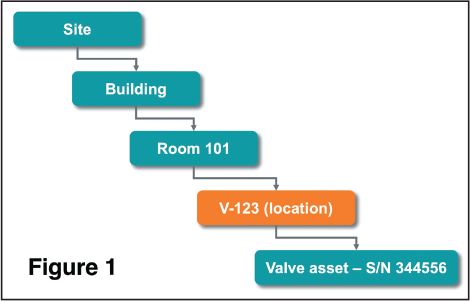
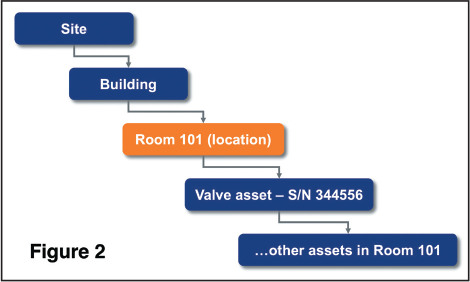
How low do you go when it comes to establishing your locations from the P&ID? Many arguments have occurred around this concept. Is it reasonable to suggest that the location for V-123 should just be Room 101? Or, in the context of how your organization captures costs, should V-123 be its own location within (under) Room 101? In that case the hierarchy would look like Figure 1. If the simpler approach will suffice, you’d have Figure 2.
The subtlety here is that V-123, as listed on the P&ID, is acting more as a location than an asset. V-123 is a description of where the device is in the system, not the actual piece of equipment (a valve) that is at that location.
While the initial design specifies the type of valve that needs to be at Location V-123, over time as the valves are replaced, completely different looking, yet the same form/fit/function valves, may be present at V-123.
If your cost accounting approach within your EAM/CMMS needs to be able to resolve costs down to the V-123 level (and follow the asset during its lifecycle), then a location for V-123 will need to be constructed. If just Room 101 is low enough for costing, then perhaps a location for V-123 is not needed (other than Room 101).
Can P&IDs help me define asset hierarchies?
Let’s define first what an asset hierarchy is before we use it. In general, they relate “parent” and “children” assets and by extension the spare parts needed for either or both. This gets a little tricky, so let’s use an example to illustrate.
Let’s pretend that the asset at V-123 is two: one is the valve itself (S/N 233445) and the other is the valve controller (S/N XCT1234). These two assets might just be one unit that move around together. Alternatively, they could be separate, treated as individuals. In this case, the valve is the parent and the controller is the child. Over time, the parent valve may have many different controllers move in and out of the child position.
The decision you must make is the value of establishing this parent/child relationship at the asset level. If they are never separated, maybe defining only a single asset (the valve S/N 233445) is enough.