
March 23, 2026
Maintenance has as one of its foundational principles the 2nd Law of Thermodynamics—entropy. The 2nd Law of Thermodynamics states that the entropy of the entire universe, as an isolated system, will always increase over time. Without the proper understanding of entropy, when it comes to modern maintenance management, organizations will continually struggle with meeting their safety, environmental, and financial goals.
Understanding the law of decay and properly managing for our desired outcome is necessary to maximize the utility of our assets. As much as we may wish for our equipment not to degrade, it will. We cannot wish away Newton’s Laws and, when it comes to maintenance, we cannot wish away the 2nd Law of Thermodynamics.
SPINNING PLATES
As discussed in this text, “maintenance” is not addressing only “the maintenance department.” Rather, we’ll use a broader definition, encompassing all aspects of activities that maintain the function or utility of our assets or systems. In this sense, the maintenance function is about activities that keep our assets doing what we want them to do. As our assets are continually degraded by entropy, we must continually eject energy in the form of maintenance back into our assets to preserve the asset’s utility.
As an example, consider a juggler who is spinning a plate on the end of a stick; let’s consider the “asset system” to include the juggler, stick, and plate. If any of these elements stop performing their function, the asset system will no longer provide its desired outcome. In the short term we do not expect the plate, stick, or juggler to “degrade”—but the juggler must continually inject energy into the system to keep the plate spinning.
Now, let’s consider a pumping system made up of an electric motor, coupling, and pump. Over time, these components will degrade; what prevents the loss of function is the injection of maintenance energy into the system to maintain functionality the same way the juggler injects energy into the stick, and the stick transfers energy to the plate. In the pump and juggler examples there are at least two forms of energy being applied:
- Mechanical energy, which the juggler imparts to the stick and the stick to the plate—just as the electrical motor imparts mechanical energy to the coupling, which imparts energy to the pump.
- Informational/decisional energy, which is to say, the juggler decides when and when not to put energy into the system to keep it stable. The same is true for the electric motor, coupling, and pump.
We have the decision to turn the electrical power on or off, as well as decisions related to reducing the impact of the normal degradation processes acting on the system (i.e., time, temperature, fatigue, stresses, etc.). This decisional energy we inject into the motor, coupling, and pump—in the form of maintenance and reliability processes—keeps this system doing what we want it to do.
When our assets are functioning properly, the assets are at their highest potential for failure and will always naturally decay to a more stable, lower energy state. The lowest energy or most natural state of the motor, coupling, and pump is a “broken state.” It is the injection of maintenance energy that keeps the assets system working. The challenge for every organization is to determine the minimum amount of safe maintenance energy that needs to be injected back into our assets before the loss of function.
FAILURE IS INEVITABLE
As part of the maintenance function, there is an intersection of the 2nd Law of Thermodynamics (“energy” entropy) and Claude Shannon’s theory of “information entropy.” By understanding Shannon’s theory of information entropy, we can learn how to identify the maintenance energy we need.
The 2nd Law of Thermodynamics guarantees that failure is not an option, it is inevitable. Given the fullness of time, decay will occur. For instance, wait long enough and do nothing proactive and your car will break down.
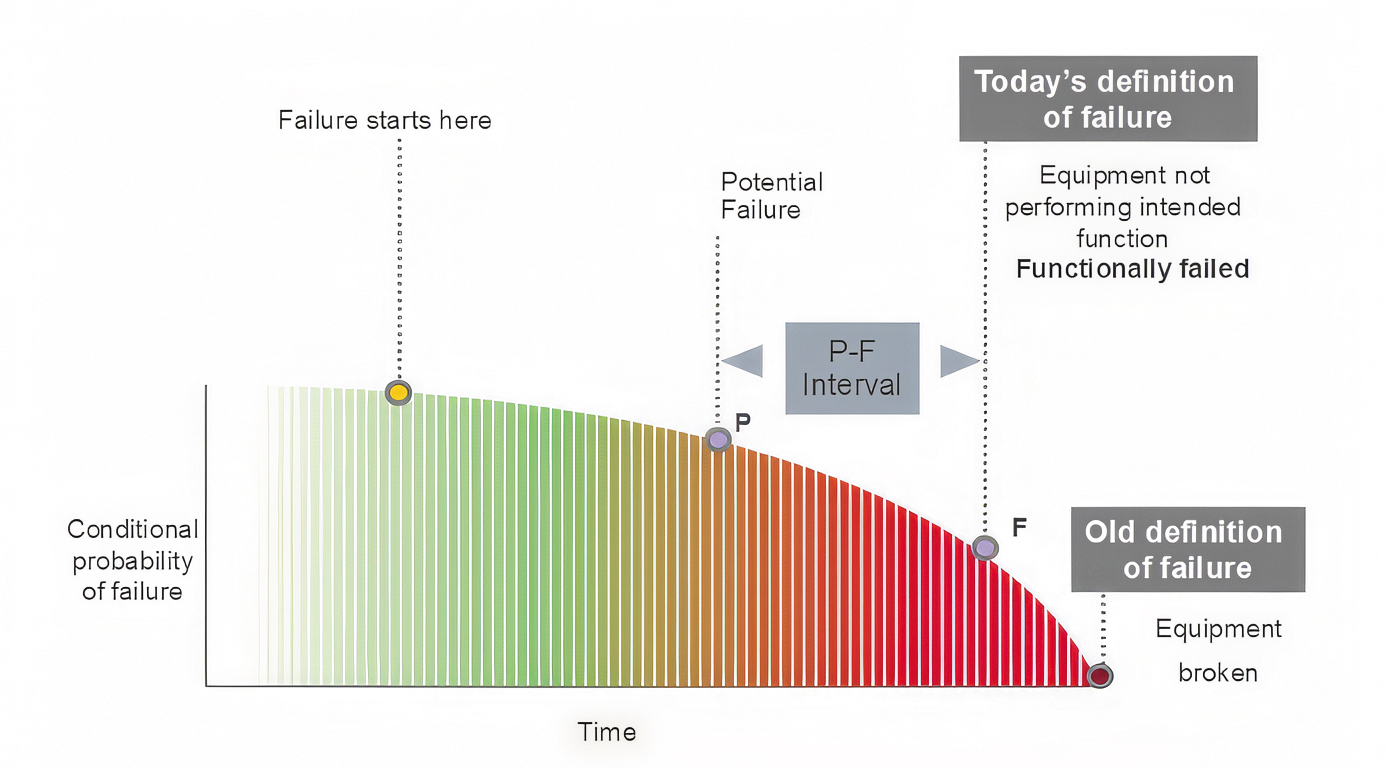
Fig. 1
This is where the concept of information entropy comes in. The pumping system will break down, but we don’t know what will break first: the motor, the coupling, or the pump. That’s the information we need. That’s the “information entropy” prediction we must answer: What part is going to fail next? We need to know where to inject our maintenance energy to prevent the loss of function. This is the intersection of “energy entropy” and “information entropy.”
To keep our pumping system functioning, we must determine what is causing it to break down. While the system is breaking down—but before it is broken down—its decay is increasing. The only way to prevent this decay from causing a loss of function is to first identify that the decay is occurring and then inject maintenance energy to restore the system’s resistance to decay.
Let’s consider the macro- (the system as a whole) and the micro- (the individual component) states. It does no good to inject maintenance energy at the macroscopic level; energy injection must be targeted at the microstate. In other words, the energy injection must be targeted at the cause of the increase in decay. For instance: “I detect a bearing race defect in the pump; therefore, I inject maintenance energy and replace the bearing, with minimal to no impact to the process.”
Replacing the failing bearing before it has “failed” is the only way to avoid the loss of function that a seized bearing will lead to. The maintenance energy is injected at the microstate (the bearing) that will cause that loss of function.
Maintenance is not hard—but it is complex. This is because all our machines are dominated by random failures. At a macroscopic level, we never know when our assets are going to start to fail. We can know that the asset will break, but not when or why. To determine when and why, we need to engage the microstate determination of Shannon’s information entropy.
INFORMATION ENTROPY
The application of Shannon’s theory of information entropy allows us to create a bias, or a “rigged game,” for determining outcomes. In Shannon’s theory, the simplest determination of outcome is a binary decision, such as a coin toss. There can only be two outcomes of a “fair” coin toss: heads or tails. In the maintenance realm, for assets and equipment we care about, we must identify randomly occurring failure modes at the correct level to drive the outcome to only two possibilities: either pending failure is identified, or pending failure is not yet of identifiable concern. In other words, either the equipment is breaking down, or it is not.
In terms of the fair coin toss, maintenance is not trying to predict the outcome of the coin toss before the toss; we are trying to determine the outcome of the toss a fraction of a second before the coin settles into its inert or decayed position. Imagine we have a high-speed camera so we can “slow down” and see the spinning or tilted coin as it lands on a surface, just before everyone else can perceive the outcome. Now we can take action before the “random” outcome is known to the other participants.
The confluence of Shannon’s theory of information entropy and the 2nd Law of Thermodynamics is a fundamental building block of modern maintenance practices. Using the practice of Reliability Centered Maintenance (RCM), we drive the microscopic information entropy to its lowest possible state: the failure mode with a binary outcome. In theory, we have overcome “information entropy” by determining—at the microstate level—which assets face pending failure, and which do not. That allows us to overcome “energy entropy” by knowing exactly where in the system to inject our maintenance energy.
The practical outcome of this process is in the form of failure mode development and the P-F degradation curve (see Fig. 1). The P-F curve is a time horizon at the individual failure mode level, with P being the point of potential failure identified (i.e., an inspection point) and F being the point of functional failure. If the state of P is such that a corrective task is required, then the interval to F must provide enough time for adequate corrective action. This P to F time horizon is formally documented during an RCM analysis, with the asset’s subject matter experts using data and their knowledge and experience of how long the progression to F will take.
For equipment we care about, we must develop failure modes that give us a binary outcome, so that when tested, they either predict pending failure or they do not. In predicting pending failure, the rate of degradation given by the P-F curve will be consistent. If the degradation curve is not consistent, this indicates either:
- a)
the failure mode has not been identified at a deep enough level to give us a binary choice (so we must refine the failure mode); or - b)
there may be no technically feasible way of measuring the outcome—therefore, condition-based maintenance (predictive maintenance) is not practical.
‘DATA’ IS NOT INFORMATION
Often we are on the hunt for data when we actually need information. Without the proper understanding of entropy and its application to modern maintenance management, organizations will always struggle to meet their safety, environmental, and financial goals. We must understand the law of decay and properly manage for the desired outcome to maximize the utility of our equipment.
The key step is to understand, at the microstate, what is the failure mode that is causing our equipment to break down. We must identify that failure mode to a granular level so that it will provide a prediction of pending failure. If the failure mode, identified at the proper granular level, cannot provide a prediction of pending failure, then we must put plans in place to mitigate future breakdowns. These mitigation strategies might include stocking spare parts, pre-planning standard jobs, installing spare equipment, etc.
We cannot avoid the practical applications of Newton’s Laws of Physics. As much as we may wish that our equipment will not decay, when it comes to maintenance, we cannot wish away the 2nd Law of Thermodynamics.
Jay Shellogg spent the last 16 years of his career working at a large pulp and paper mill, primarily as a senior environmental engineer and maintenance/reliability superintendent. During that time he encountered many challenges; in his own words, “Some I overcame, and some I didn’t.” Contact him at jayshellogg@strategicmaint.com.
Webinar: Physical Asset Management
Author Jay Shellogg will lead an upcoming webinar series on physical asset management hosted by TAPPI’s Young Professionals Division and the Engineering Division’s Plant Engineering & Project Management Committee. This engaging, informative webinar will take place over four Fridays: March 6th, 13th, 20th, and 27th, 2026. Check the TAPPI website at tappi.org for updates and registration information.