
October 16, 2025

The current business environment can be described as “the era of turbulence,” driven by the accelerating speed of change and the interconnectedness of everything. Technologies disrupt established norms, and geopolitical uncertainties add complexity. However, there are ways to navigate the turbulence, and played right, the technology is already there to assist you on your journey.
“Tissue companies are currently navigating a period of intense digital evolution, fueled by artificial intelligence (AI) and other emerging technologies,” says Ropponen, “This transformation demands a strategic and holistic approach, encompassing not only technological adoption, but also cultural change and a commitment to data-driven decision-making. Selecting the right technology partner is crucial.”
Ropponen speaks from his experience as head of Tissue at Finnish company Tietoevry, which specializes in incorporating AI into tissue applications. He says that by integrating AI into tissue production, a revolution can take place in both efficiency and profitability.
“Digital transformation isn’t new,” says Ropponen, “but its speed and impact have accelerated. Successive technology waves have built upon each other, culminating in an unprecedented era of information and intelligence. Today, cloud and edge computing, advanced connectivity, generative AI, and robotics-enabled applied AI are emerging as essential capabilities.”
THE PROMISE OF AI: VALUE CREATION AND COMPETITIVE ADVANTAGE
AI is presented as a transformative force with the potential to revolutionize various aspects of business. “We are living in fascinating times—the world we used to dream about is here right now,” says Ropponen. “We now have generative AI, Co-Pilots and AI agents and robots as examples of applications that are rapidly becoming a reality. This shift toward AI is described as a digital tsunami, impacting individuals, companies, and governments alike.”
Far from running away from the tsunami, Ropponen emphasizes the importance of finding a partner and getting involved, as the benefits could be huge. Citing an IDC report on The Business Opportunity of AI conducted in 2023, he states, “Investing in AI can deliver significant returns—up to $3.50 for every dollar spent—by enhancing efficiency, innovation, and revenue. Organizations typically realize ROI within 14 months. A subsequent IDC study reports even higher returns over a shorter period, with 77 percent of mature firms adopting an AI-first strategy.
The report also summarizes further benefits of enriching employee experience, re-writing customer engagement, gaining new business, and generating a culture of innovation.
“However, to fully leverage the benefits of AI, organizations need to embrace a strategic approach,” says Ropponen. “One good place to start is to reference Microsoft’s AI strategy roadmap, which encompasses organizational culture, business strategy, applied AI, AI experience, AI governance, and technology strategy.”
OVERCOMING BARRIERS TO AI ADOPTION
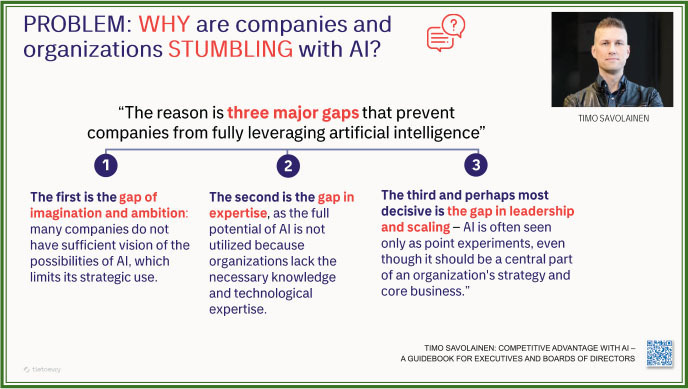
Despite the potential of AI, Ropponen refers to T. Savolainen’s AI Guidebook that says organizations are facing significant challenges in adopting and implementing AI solutions in three key areas:
- Gap of Imagination and Ambition:Organizations do not have sufficient vision of the possibilities of AI, which limits its strategic use.
- Gap in Expertise:The full potential of AI is not utilized because organizations lack the necessary knowledge and technological expertise.
- Leadership and Scaling Challenges:Effective leadership is crucial for driving AI initiatives and scaling them across the organization as part of the strategy and core part of the business.
Ropponen emphasizes, “To overcome these barriers, organizations need to cultivate a culture of innovation, invest in AI talent and skills, and develop a clear AI strategy aligned with their business objectives.
“Implementing an AI strategy is not an option anymore. Around 90 percent of organizations are now investing in digital initiatives, and it is already being proven at these companies that the more they invest, the more they gain.”
Ropponen underscores the critical role of data quality in successful digital transformation and AI implementation. “Data is the new oil in business manufacturing, and it really is a situation of garbage in, garbage out. The quality of data directly impacts the accuracy and effectiveness of AI models and the insights they generate. Organizations need to invest in data governance, data cleansing, and data integration to ensure that their data is reliable and readily accessible.
To achieve this, a robust technology strategy and the selection of partners aligned with industry best practices are essential. “Tietoevry’s TIPS MES (Manufacturing Execution System) exemplifies this, serving as the operational backbone by centralizing key data to support decision-making and drive efficiency through KPIs such as Overall Equipment Effectiveness (OEE),” says Ropponen.
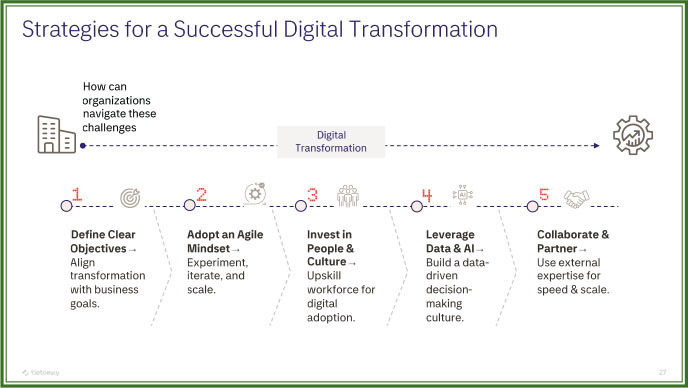
FIVE STEPS TO ACCELERATING THE DIGITAL TRANSFORMATION
There are five steps to begin navigating into digital transformation, says Ropponen: define clear objectives; adopt an agile mindset; invest in people and culture; leverage data and AI; and collaborate with a partner. “The last step is really important,” he says. “Organizations need to partner with the right technology providers, share best practices, and foster a culture of experimentation and innovation.
“To thrive in this age of acceleration, organizations must embrace digital transformation, prioritize data quality, cultivate a culture of continuous learning, and collaborate with the right partners. By taking these steps, companies can unlock the full potential of AI and other emerging technologies, creating new value for their customers, employees, and stakeholders.”
Ropponen concludes: “The journey may be turbulent, but the potential rewards are immense. The time to act is now. The future belongs to those who innovate today.”