
May 22, 2026
The increasing use and deteriorating quality of wastepaper poses significant challenges for paper and board manufacturers. The fibers become shorter and weaker with multiple recycling, which has a negative impact on the strength and other properties of the finished product. One of the main issues is stickies and fibers, which are pulled out of the paper web in the dryer section and build up on the surfaces of the drying cylinders, guide rolls, dryer fabrics, and doctor blades.
Clogging the drying cylinders and dryer fabrics reduces heat transfer and evaporation and thus increases the specific energy consumption. It also leads to breaks and paper defects, resulting in customer complaints and considerable costs. Various approaches have been tried to solve this challenge, including:
- Adding polymers or platelet-shaped pigments in the approach flow system;
- Coating the drying cylinders; and
- Spraying additives onto drying cylinders and dryer fabrics.
However, these solutions are limited in terms of their scope of application and success.
THE SOLUTION
USING PCA TECHNOLOGY
The surfaces of drying cylinders, dryer fabrics, and guide rolls are provided with a protective layer (passivated) to prevent contamination and sticky substances from adhering. The release agent Polyclean is applied, as a very thin film, continuously over the entire machine width using a patented Polyclean Applicator (PCA) via a wick onto the surface to be treated.
This technology is provided by CTP GmbH, headquartered in Schwabmuenchen, Germany. Founded in 1994, CTP supplies customers in 34 countries worldwide with additives for paper and board production and finishing. With a passion for papermaking, CTP provides customized solutions based on customer requirements. In addition to the development and production of additives for coating colors and specialty papers, CTP also offers a wide range of solutions, including for problems caused by stickies.
When treating dryer fabrics, the Polyclean is applied to a guide roll, which then transfers the additive to the dryer fabric, similar to an indirect printing process. By reducing adhesion, the adhesion of the wet paper web to the dryer cylinders, dryer fabrics, and their guide rolls is significantly reduced. This noticeably reduces dusting and picking and prevents clogging of the cylinder surfaces and dryer fabrics, as well as the accumulation of sticky deposits in front of and behind the doctor blades.
POLYCLEAN AND
THE PCA TECHNOLOGY
The application wick consists of an aramid fabric braided around a flexible and perforated tube (Fig. 1). The aramid fabric of the wick has very high strength and excellent abrasion resistance. Aramid is used in the aerospace industry and for bulletproof vests. It is highly heat-resistant and can withstand temperatures of over 500°C.
The Polyclean is pumped into the perforated tube using a special dosing system. The Polyclean is pressed through the holes in the hose and the wick is evenly soaked from the inside. The wick then transfers the Polyclean to the surface to be treated.
As every paper machine is unique, each application must be specially designed; there is no one-design-fits-all solution. Three different custom PCA variants are available (Fig. 2).
Thanks to the various PCA designs, this technology can be used for passivation at almost any position on the paper machine. Most applications are installed on dryer fabrics and drying cylinders, but this system also offers solutions in the press area or on the calender. Fig. 3 shows examples of an installation on a doctor beam, and on an extra beam that is used as a support for the PCA-S; and installation of a PCA in an existing blade holder.
PCA offers mills and plants the following advantages:
- Clean surface of the treated and the following cylinders;
- Improved heat transfer, lower steam consumption, lower energy costs;
- More uniform moisture cross profile;
- No dust or stickies on and behind the doctor blade of the treated and following cylinders;
- Significantly less dust and thus a lower risk of fire and dust explosion;
- No spray mist in the surrounding air that can be inhaled;
- Fewer customer complaints due to dust on the paper surface, especially beneficial for printing papers;
- Reduced cleaning time;
- Higher cylinder temperature possible, resulting in increased speed and production; and
- Fewer breaks on the PM, on the rewinder and during further downstream processing steps.
During development, CTP built the most energy-efficient application possible. The power consumption of the dosing system is approximately 100 watts; only the PCA-S and PCA+ are loaded with compressed air, as with a doctor blade, so almost no compressed air is consumed. This means that, aside from the cost of the Polyclean release agent, there are almost no operating costs for the mill.
An application can be started without any investment, as CTP handles project planning, equipment costs, and implementation. All that is required from the mill is a power and air connection. For optimal automatic operation, the system can be integrated into the DCS. There is no contract for the paper mill for a minimum term or minimum purchase quantity.
The application also sets a new standard in terms of occupational health and safety as the direct transfer of the passivation agent means that there is no spray mist. Therefore, this product is not atomized in the working environment.
CASE STUDY: SW GUADALUPE MILL
PM7 at Smurfit Westrock’s mill in Gaudalupe is the fastest and newest green field PM for corrugated base paper in Mexico, with up to 1,200 m/min and a working width of 6.65 meters. It was started up January 2021 and produces around 350,000 tpy of medium and testliner grades, with a basis weight of 100 to 250 g/m² on a 100 percent recycled paper basis.
The problems were dust build-up and sticky residues on the first cylinders and their doctor blades in the first dryer group. CTP and the mill team discussed the situation and jointly concluded that installation on the first cylinder (Fig. 4) would be the best solution to achieve the greatest possible benefit in the short term. The application was planned with the installation of a PCA-S behind the doctor blade.
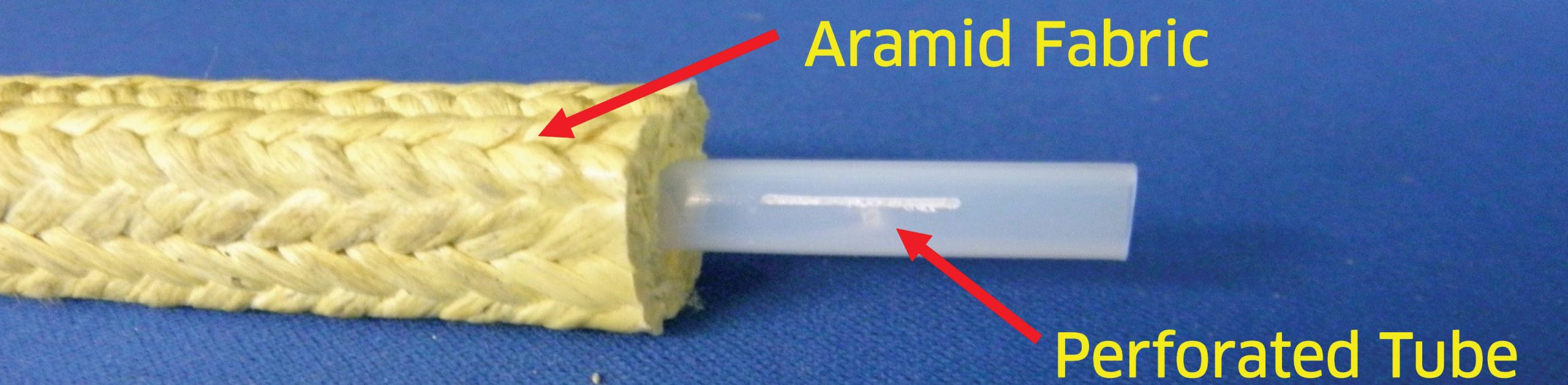
Fig. 1: The application wick uses an aramid fabric braided around a flexible, perforated tube.
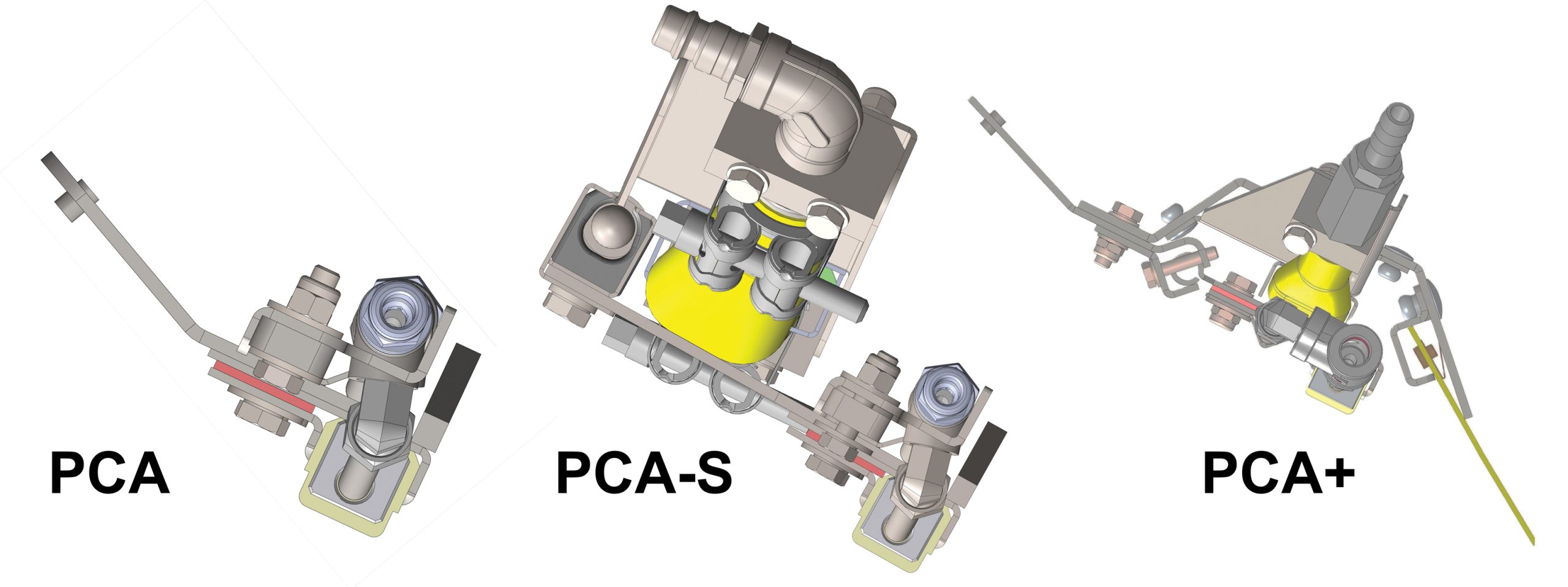
Fig. 2: From left: The PCA can be inserted into an existing doctor blade holder; the PCA-S is mounted on the doctor beam or an extra beam; and The PCA+ can also be inserted into an existing doctor blade holder.
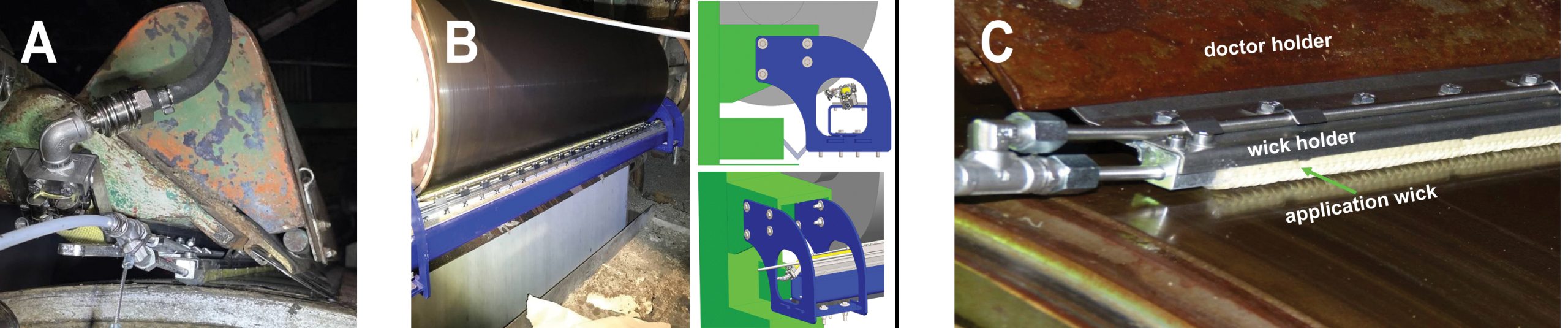
Fig. 3: A: Installation of PCA-S on doctor back; B: Installation of PCA-S on extra beam; C: Installation of a PCA installed in an existing blade holder.
The installation was carried out during a scheduled 12-hour shutdown of the machine. Smurfit Westrock supported the operation by lowering the doctor beam, which allowed CTP tocomplete the installation before the mill staff returned the doctor beam to its operating position. In the final step, CTP adjusted the application to the correct position to ensure that the passivation was applied correctly across the entire width.
Operations Manager Manuel Enrique Fuzy is happy with the results. “The passivation program was on hold for several months, and after trying the product for the first month, we regret not taking the leap sooner. The most surprising change was the lack of dust around the first dryers with the passivation, something we value greatly to keep our machine hazard free.”
The continuous application of the passivation additive Polyclean across the entire machine width has resulted in the following improvements:
- Clean surface of the treated first and the following 2 to 3 cylinders (Fig. 5);
- Significantly less dust in the first dryer group, reduced risk of fire;
- Reduction of sticky deposits in front and behind the doctor blades and thus reduction of complaints due to stickies;
- Significant cost savings and significantly better results after reducing chemicals in the approach flow system, which are used to prevent sticky deposits;
- Higher machine efficiency;
- Fewer breaks and paper defects.
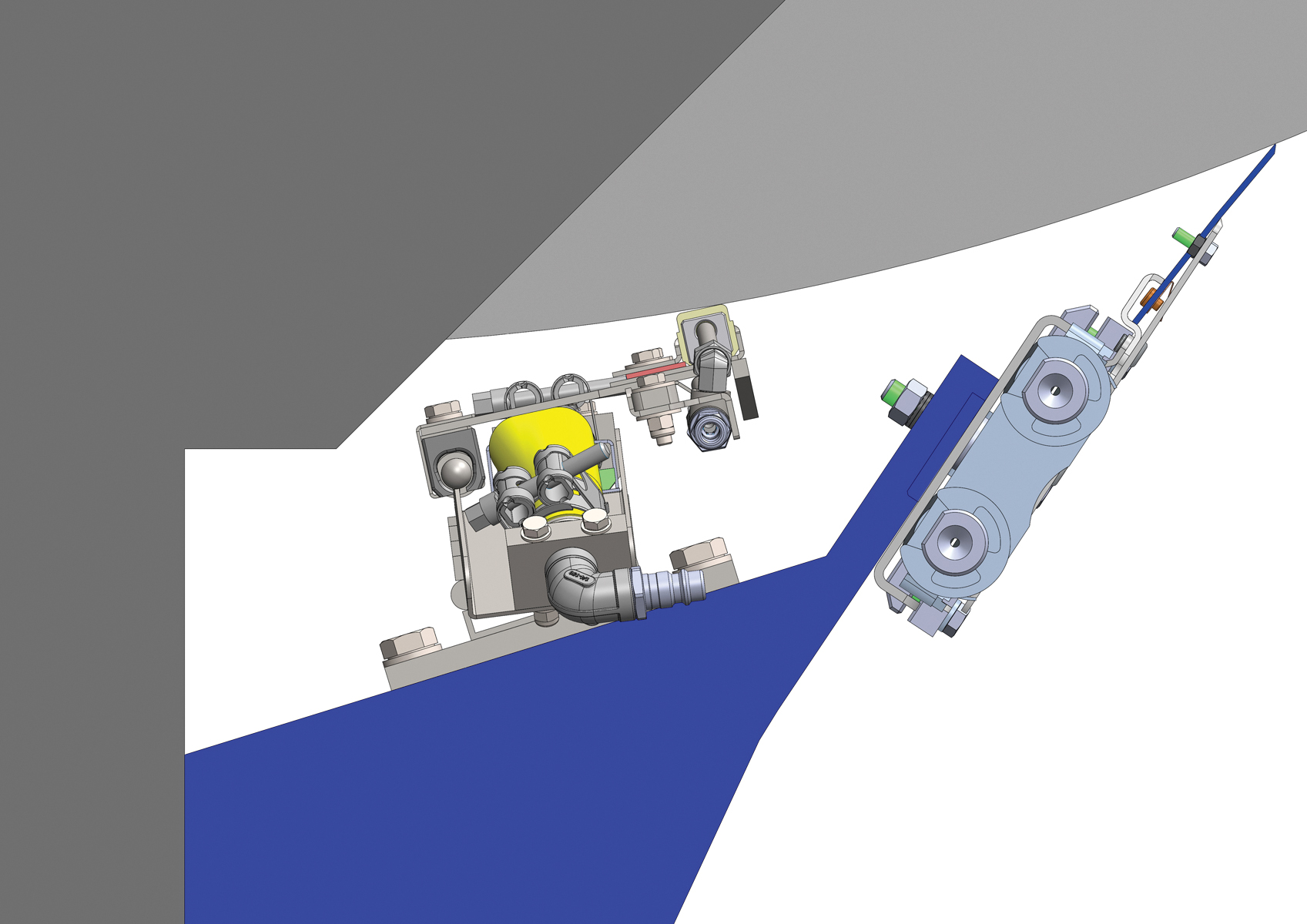
Fig. 4: Polyclean application directly onto Cylinder 1, after the doctor blade, at SW Guadalupe.
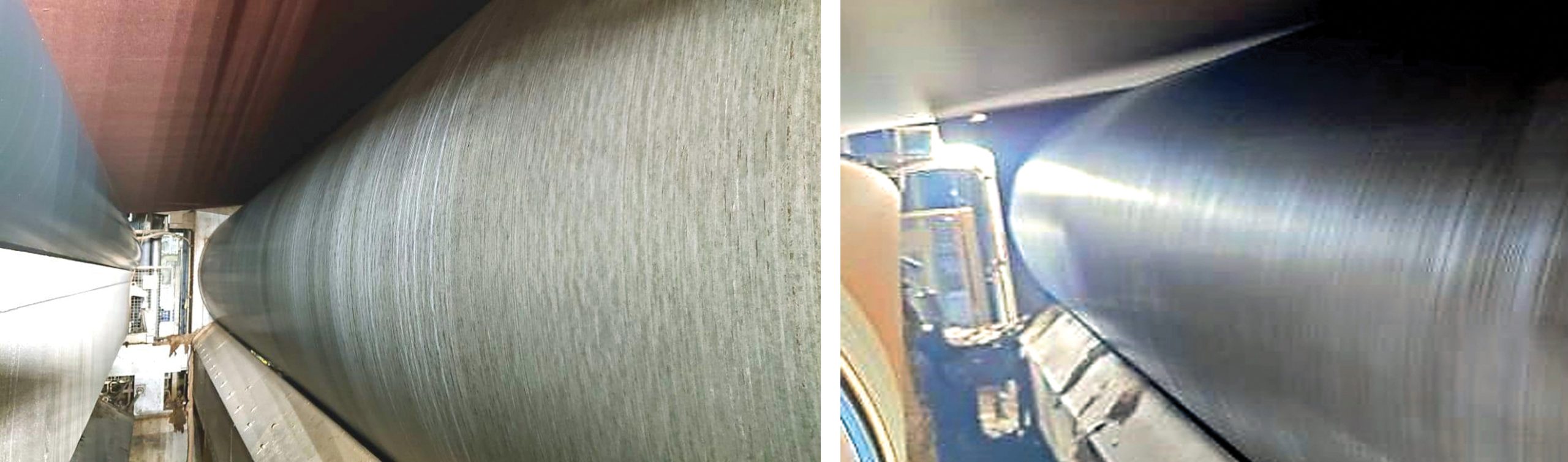
Fig. 5: At Guadalupe mill: Cylinder surface (left) before PCA passivation, its surface covered with sticky deposits; and with PCA passivation, showing a cylinder surface free of deposits.
Further advantages are the simple installation and start-up of the application, plus reduced downtime due to doctor blade removal (previously once every day, now only once a week). However, the prerequisites for application are good performance of the doctor blades on the cylinders, inspections by shift personnel, and regular maintenance by the CTP service.
“It was a practical and easy solution to our sticky problem under the doctor blades,” says Abraham Martinez, process engineer. “It demonstrates cost-effectiveness and its automation was properly executed, ensuring operational stability, reduced variability, and constant process results.”