
March 23, 2026
Corrugated boxes made from renewable wood fiber are far more than a ubiquitous packaging solution; they are a cornerstone of global commerce and a vital indicator of economic vitality. In the United States alone, the corrugated packaging market is valued at over US$35 billion annually, representing more than 30 percent of all packaging produced. These boxes are the silent enablers of supply chain efficiency, protecting goods in transit and serving as the first physical touchpoint between companies and consumers in the rapidly expanding world of e-commerce.
But the economic impact of corrugated packaging extends well beyond the packaging sector itself. More than 90 percent of all products in the US are shipped in corrugated containers. This ubiquity means that box demand closely tracks GDP growth and consumer spending, making it a leading indicator of broader economic activity. When box shipments rise, it signals robust trade across a range of industries, from agriculture and food to pharmaceuticals and durable goods. Conversely, a slowdown in box demand often foreshadows broader economic headwinds.
2025 MARKET DYNAMICS: NAVIGATING HEADWINDS AND STRUCTURAL CHANGE
The first half of 2025 was marked by persistent economic uncertainty in the US, with GDP remaining below 2024 levels and inflation rising to 2.5 percent. Manufacturing output continues to contract, and consumer sentiment has declined, even as personal consumption expenditures (PCE) on goods and services have grown year-over-year—driven more by inflation than by real volume growth.
Within this context, the North American containerboard sector—i.e., those responsible for producing corrugated boxes—faces its steepest annual capacity decline in 15 years. By the end of 2025, containerboard capacity was projected to fall by three million tons, led by industry leaders such as International Paper and Georgia-Pacific, with most reductions in kraftliner grades. This contraction follows a decade-long wave of capacity build-up, particularly in recycled grades, and is a direct response to weakening demand, declining exports, and broader economic headwinds.
Both GDP and consumer spending were weak in Q2 2025, with manufacturing output still in contraction and double-digit declines in box exports. US box plant demand has softened across end-uses, and even e-commerce—once a growth engine for box demand—has seen reduced box intensity as companies optimize packaging and logistics.
A SECTOR IN TRANSITION: CAPACITY RATIONALIZATION AND MARKET LEADERSHIP
Despite the sharp capacity reductions, the North American containerboard market remains highly consolidated. The top five producers account for approximately 75 percent of total capacity, even after the 2025 cuts.
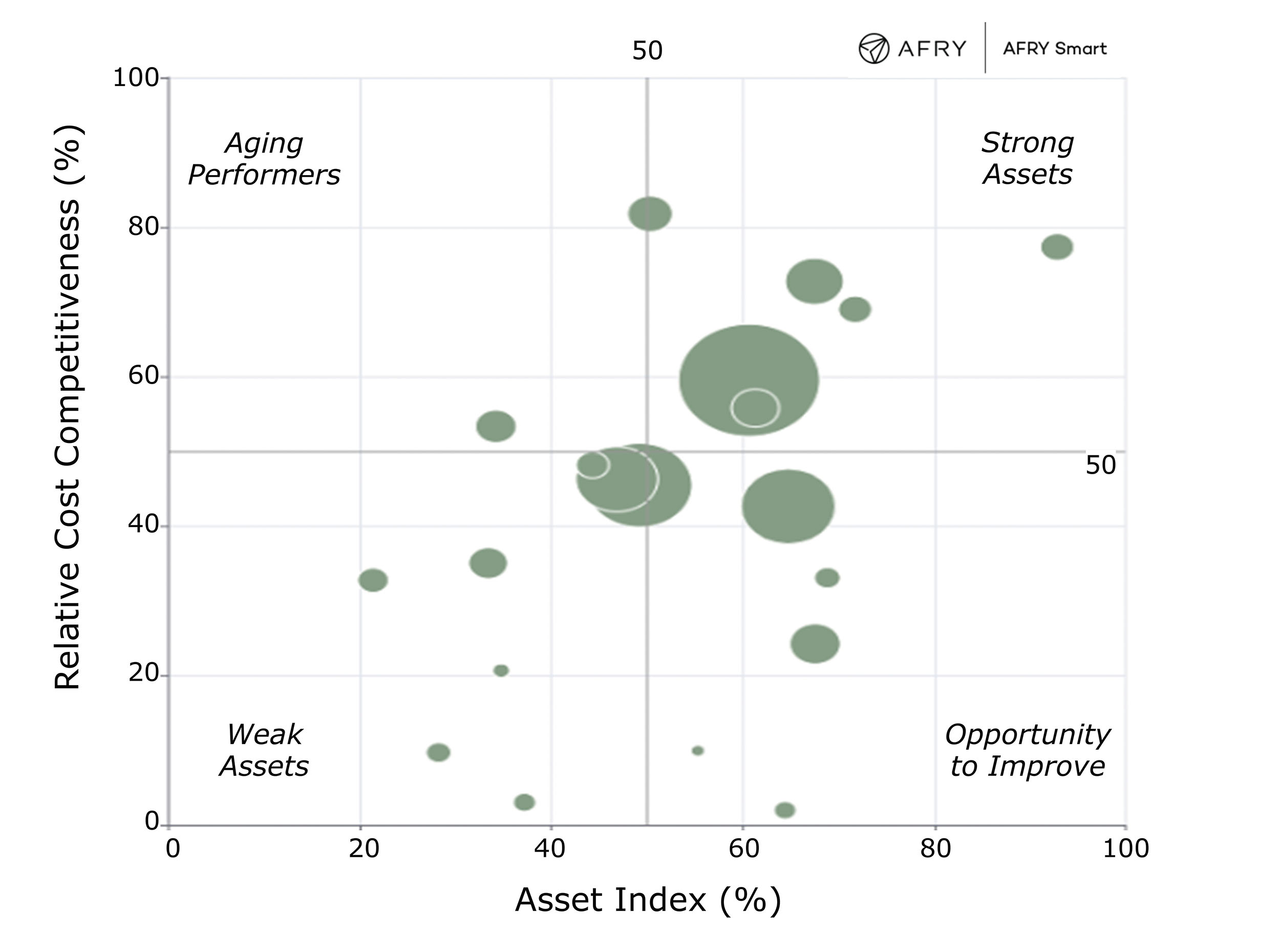
Industry leaders have taken the brunt of the reductions, with International Paper removing two million tons, Georgia-Pacific one million tons, and Smurfit Westrock and Cascades also executing significant closures. Yet, AFRY’s mill viability analysis suggests that large volumes remain “at risk,” and further closures may be on the horizon as producers continue to rationalize assets in response to shifting market dynamics.
Mill viability is assessed through a combination of relative cost competitiveness and asset index benchmarking against industry peers (see Fig. 1). The Asset Index is a composite score reflecting the physical condition of a mill’s equipment, typically based on factors such as maintenance history, capital investment, technical age, machine size, and alignment of the asset with the target grade. Circles represent individual companies, expressed as an aggregate of all their paper machines. Quadrant location and thus competitive positioning can change due to several factors, including the closure of uncompetitive machines, process optimization, and machine upgrades.
In an environment characterized by volatility and rapid change, access to high-quality business intelligence is more critical than ever. Tools like AFRY Smart, an advanced online analysis platform, empower pulp and paper companies to make informed decisions with up-to-date data and tailored analytics. As the sector navigates capacity rationalization, shifting demand patterns, and evolving sustainability requirements, leveraging such intelligence will be key to maintaining competitiveness and resilience.
CORRUGATED PACKAGING AND
THE CIRCULAR ECONOMY
Beyond its economic significance, corrugated packaging is a model of circularity and sustainability. According to the American Forest and Paper Association (AF&PA), North American recycling rates for corrugated boxes have reached around 70-75 percent, creating a steady supply of recovered fiber for reuse. This reduces dependence on virgin pulp, supports sustainable forestry, and helps the industry meet ambitious environmental targets.
In a world increasingly focused on Environmental, Social, and Governance (ESG) performance, the corrugated sector stands out for its tangible contributions to the circular economy.
CONCLUSION: CORRUGATED
BOXES AS A FOUNDATION
FOR RESILIENT TRADE
Corrugated boxes are not just packaging; they are a vital barometer of economic health and a foundation for resilient, sustainable global trade. As the sector adapts to new economic realities, the ability to innovate, optimize, and embrace circularity will define its future success. The story of corrugated packaging in 2026 is one of both challenge and opportunity, which is a testament to the enduring importance of this humble, yet indispensable, product.
Alexander A. Koukoulas, Ph.D., is Independent Advisor, Pulp & Paper and Bioeconomy; and Olivia Ying is manager for AFRY Management Consulting, Inc. AFRY provides engineering, project management, and advisory services that enable the energy and industrial transition and strengthen resilience in society. Visit afry.com.
Fig. 1: Relative cost competitiveness of US containerboard producers as a function of Asset Index.