
September 8, 2025
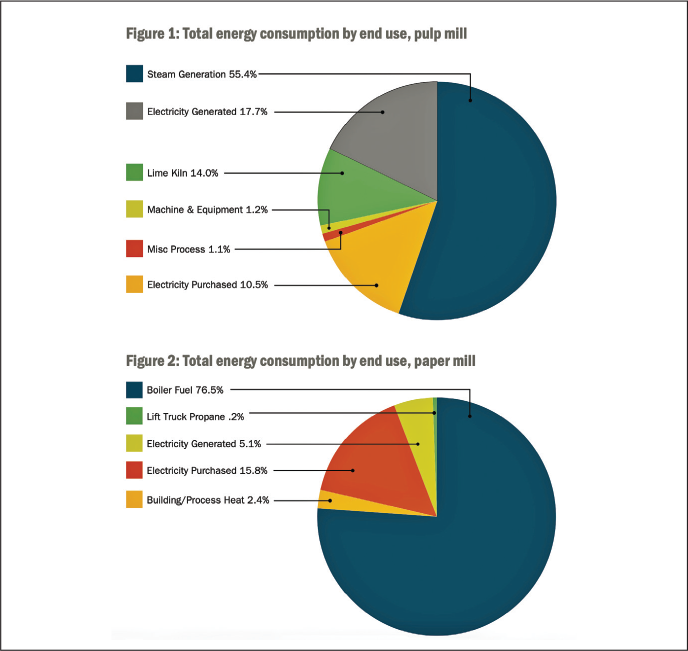
Pulp and paper is an energy intensive industry. Efficient use of energy represents one of the most controllable costs for a site. Identifying and applying energy efficient strategies aligns with corporate sustainability goals while reducing the overall cost of operation. The bonus? Mills often see a corresponding improvement in product quality from reduced process variation, plus improved reliability through the proper sizing of equipment.Energy costs range from 10-40 percent of total manufacturing cost. Figures 1 and 2 illustrate how that energy is typically consumed. Energy-related myths and the “that’s the way we have always done it” mentality are significant limitations in many mills. These beliefs often defy the laws of physics.
A RESOURCE FOR MILLS
To help mills achieve their energy targets, Focus on Energy—Wisconsin utilities statewide program for energy efficiency and renewable energy—has created the Pulp & Paper Industry Energy Best Practices Guide. The Guide reflects more than 250 years of pulp and paper industry experience by its authors (including the author of this article) and includes recommendations compiled from energy evaluations conducted in more than 300 mills and at several paper companies. It includes recommendations from many energy experts and vendors. A printable copy is available online at no cost (use the QR code on the next page to access).
We authors estimate that US pulp and paper mills can achieve a 3-5 percent annual energy reduction with a sustained energy efficiency culture. One estimate is that energy consumption in pulp and paper mills can be reduced by US$1 billion per year by following guidelines in the energy Guide. Ongoing energy reduction through efficiency will significantly improve sustainability in pulp and paper mills and reduce mill closures. Many energy reduction projects can be implemented without capital expenditures.
Some paper companies have done an excellent job of focusing on energy reduction opportunities included in the Guide. For example, International Paper has focused on recovery of excess heat generated in pulp mills and utility plants with reuse on paper machines and other areas of the mill. Graphic Packaging reduced energy consumption in all paper mills by 25 percent in a five-year period using information in the Guide. Graphic Packaging International had assistance from CleanTech Partners in identifying energy reduction projects and a corporate energy manager to coordinate implementation of projects identified. Many of the Guide’s best practices have been incorporated into the design of recent new paper mill projects.
THE MEASUREMENT CHALLENGE
Process measurements and controls are major limitations to reducing energy use in many mills. Energy audits have revealed that, at some facilities, process measurements are incorrectly displayed by as much as 100 percent. Valves sometimes incorrectly indicate whether they are open or closed.

Yet heat exchangers and other equipment cannot function without accurate flow measurements. The Guide cites one container-board machine where the crew thought they were operating with whitewater temperature of 150oF, but it was actually 130oF due to a calibration error.
Portable flow meters have been successfully used to verify measured and unmeasured process flows. One integrated pulp and paper mill that focuses on upgrading instrumentation and process controls reduced annual energy consumption by US$3 million (15 percent).
WATER, STEAM, AND CONDENSATE
Steam and condensate system design and operation and reduction of water consumption on PMs are major opportunities to reduce energy consumption. Process modeling of these systems has been a valuable tool in optimizing energy use.
Even some new PMs do not have efficient steam and condensate systems. One example is that OEM steam joints and syphons supplied by machine builders, create excess steam blowthrough and often do not provide reliable service.
TAPPI TIP 0404-63 includes a guideline that 85 percent of steam delivered to paper machines should be returned as condensate to the steam generation plant. We have measured condensate return below 70 percent. Condensate is like gold and has a value around US$3,000 per gpm per year. Many paper machines have issues with:
- Steam leaks
- Incorrect differential pressures
- Lack of/incorrect size of orifice plates installed with stationary syphons
- High flows to condensers
- Thermocompressor sizing and operation
- Syphon and steam joint issues
- Condensate pump maintenance
- Lack of steam trap inspections, with application design review of repeat fail units
- Steam/water hammer, which destroys steam/water heat exchangers
Inveno Engineering and the Department of Energy have published excellent series on steam best practices that are referenced in the Guide and are available online.
Water use per ton has historically been high on PMs. Most mills were built near rivers when water was inexpensive. Pulp mills have excess heat, and many integrated mills are recovering heat and heating water for PMs and other applications. Also, for some grades, wet end chemistry requirements restrict how low water use per ton can be. The Guide outlines several key factors in reducing water use:
- Use of clarified whitewater in showers.
- Saveall in good operating condition.
- Auxiliary filtration equipment for further clarification of shower water.
- Use of excess whitewater for consistency control and pulper dilution.
- Monitoring and controlling vacuum pump seal water/installing vacuum blowers.
- Reducing seal water flows to pumps, rolls, and other rotating equipment.
- Shutting off seal water on pulpers and other equipment that is shut down.
CLEAR OPPORTUNITIES
The Guide includes a host of other opportunities to reduce PM energy consumption.
Optimizing refining: Using splined rotors for disk refiners can allow mills to reduce no-load horsepower by 10-12 percent. Wisconsin paper mills have more splined rotor conversions than any other state due to incentives offered by the Focus on Energy program. Several mills have converted to low intensity refiner plates on machines using hardwood pulp and secondary fiber. On one fine paper machine we researched, installing low intensity plates in hardwood refiners let the mill shut down a refiner, saving US$100,000 per year in electricity. Installation of low intensity refiner plates on some machines has permitted eliminating use of enzymes.
Reducing whitewater temperature: One fine paper machine reduced whitewater temperature from 124oF to 115oF and reduced steam cost by more than US$2 million per year without adversely affecting production rates. The most energy-efficient whitewater temperature varies depending on other parameters that restrict production rates.
Optimizing vacuum system performance: The Guide details many tips for improving vacuum system performance, including:
- Eliminate (rather than rebuild) old, inefficient vacuum pump designs.
- Monitor seal water application.
- Reuse vacuum pump seal water.
- Test/inspect liquid ring vacuum pumps regularly; rebuild when performance falls to 80 percent of design.
- Replace suction presses and shut down vacuum pumps.
- Consider replacing liquid ring pumps with vacuum blowers; eliminate use of seal water and provide heat recovery opportunities.
Optimizing press section operation: Efficient press section dewatering is critical for achieving energy efficiency on paper machines. Steam required in drying is reduced 3-5 percent for each one percentage point increase in sheet dryness leaving the press section; the highest reported drynesses leaving the press section are around 56 percent. The Guide includes several changes that can improve press section dewatering.
Lowering pocket ventilation supply air temperatures: Some papermakers feel that higher air temperatures here increase paper machine drying rates. The Guide reports that several PMs have reduced PV supply air temperature below 150oF without adversely affecting production rates while reducing steam for heating air. A good paper machine hood is required to operate with low PV supply air temperatures.
Installing variable frequency drives: Mills have installed variable frequency drives in many applications. A general rule of thumb is that installations of VFD operate at 50 percent of normal running load with conventional drives.
Installing energy-efficient agitators and rotors in stock chests and pulpers: Nearly all agitators in stock chests installed before 1990 were propeller designs; there have been many design changes in pulper agitators and rotors since then. Development of energy-efficient profile designs have reduced energy consumption by 20-25 percent.
Reducing PM lost time: Several mills have reduced lost time by focusing on improving maintenance performance through better equipment monitoring, scheduling maintenance, and doing precision maintenance. The TAPPI guideline is that unscheduled maintenance lost time should be less than one percent; the lowest we have seen is 0.4 percent. Machine startups and shutdowns increase energy consumption.
ARE YOU A WORLD-CLASS ENERGY USER?
The opportunities are too rich, and the benefits are too important, to miss the chance to improve your mill’s energy management. Energy costs can be controlled through implementation of practices and methods contained within the Energy Guide.
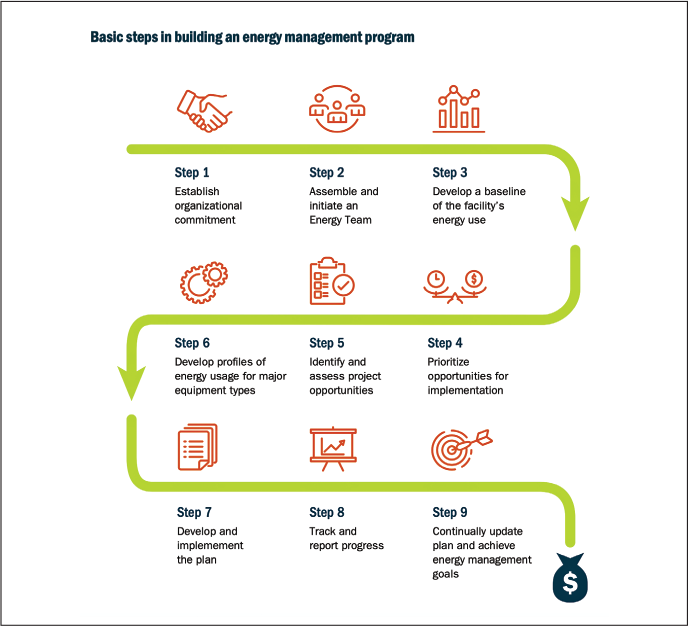
This article merely scratches the surface of the information in the Guide. With extensive best practices for both pulp and paper mills; tips and guidelines for developing a site-specific energy management program (Figure 3); and successful practices gathered from the authors’ visits to working pulp and paper manufacturing facilities, this free Guide will help your facility set, and meet, energy goals to reduce costs and improve performance.