
April 24, 2026
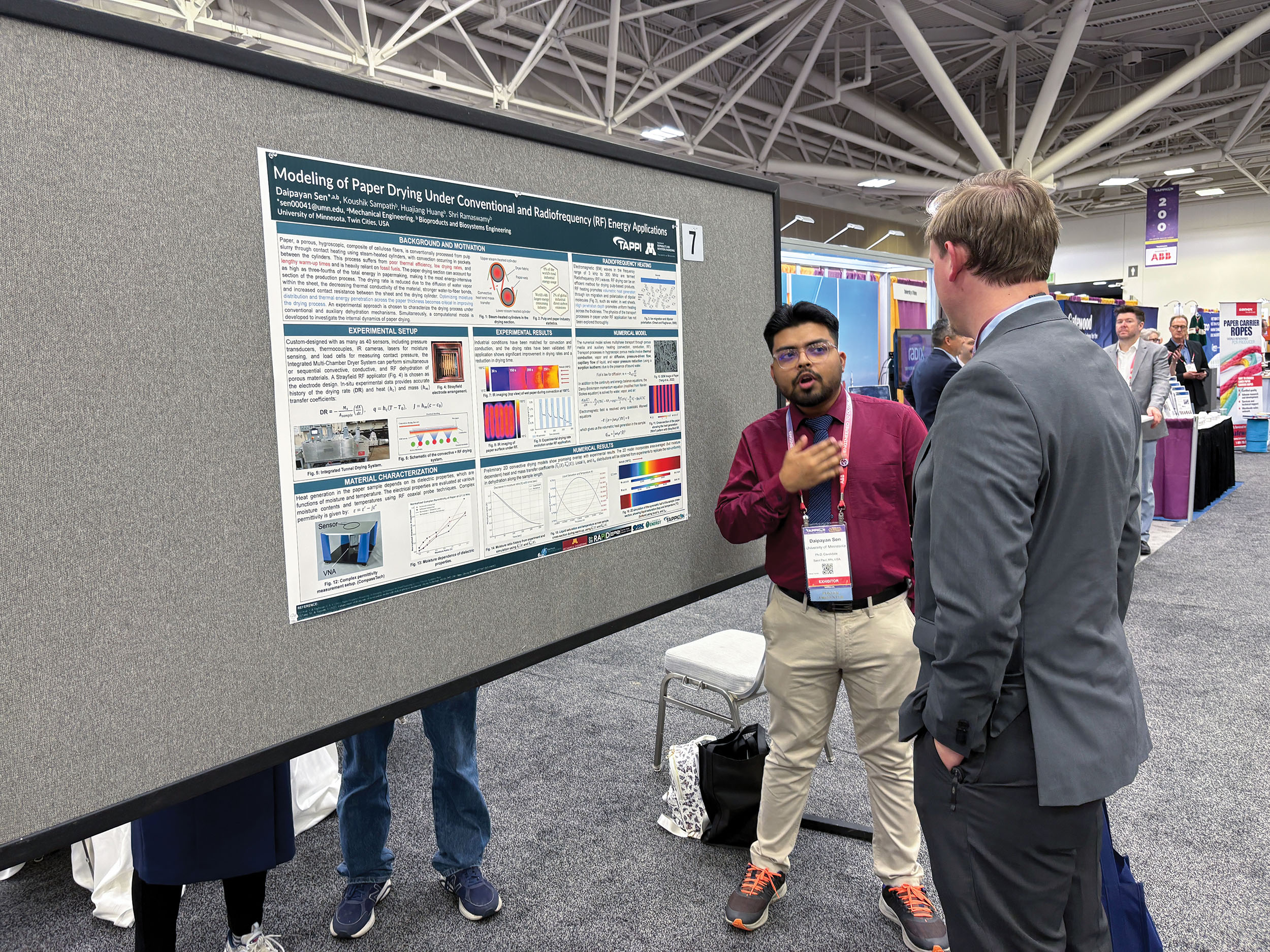
Nate Manni, Liberty Paper (back to camera), discusses a paper drying research project with Daipayan Sen, a PhD candidate from University of Minnesota, at the TAPPICon 2025 Poster Session. Liberty donated resources to the school for the project.
No one with experience in the paper, tissue, or packaging industries would say it’s better to “stop learning.” Want to see the latest new technologies? “No, thank you.” Care to meet vendors, peers, and SMEs? “Sounds boring.” These aren’t the answers that push us forward.
That’s why these takeaways—knowledge, new tech, and networking—are top-of-mind for the TAPPI volunteers and staff who plan each year’s TAPPICon. Yet in an often understaffed and overwhelmed manufacturing sector like forest products, it can be tough to get mill crews away long enough to attend a conference. Which leads us to the most important question:
Is it worth it?
Last year, Liberty Paper’s mill in Becker, MN, took full advantage of proximity and sent 24 mill folks into nearby Minneapolis for TAPPICon 2025. The Becker Mill churns out 260,000 tpy of 100 percent recycled paper for boxes; it’s a busy facility with a customer list that ranges from local small businesses to Fortune 500 companies.
Paper360° Editor Jan Bottiglieri caught up with two of Liberty’s 2025 TAPPICon attendees: Tom Murphy, technical services manager; and Nate Manni, process engineer for Liberty’s DreamWorks Coating Solutions. Here, they talk about takeaways from participating.
P360°: Tom and Nate, can you tell me a little about Liberty’s TAPPICon participation—and your personal experiences?
MURPHY: Usually when we go to TAPPICon we plan to send four or five people and everyone is jockeying to see who can go. Last year, the mill happened to be around an hour from the venue, so the list kept growing. The mill rate helped; sending more people wasn’t that much more money. Nate went down early and did the YP events on Saturday and Sunday. A number of our attendees were operators who don’t always get a chance to attend; they were walking booth to booth and trying to catch a seminar here or there and they came back with wonderful things to say.
MANNI: At the YP mentorship session, we were able to ask industry veterans questions like “Where did you start? Do you have any career pathways, or tricks of the trade? Have you ever had this issue in your career?” That gave me ideas I could bring back to the mill of things we hadn’t thought of, from someone who already went through a similar struggle.
MURPHY: I’ve been in the industry well over 30 years and I’ve met a lot of people. Being able to network at TAPPICon is unbelievable. Last year I got to touch base with a lot of long-lost friends—and also people I contacted just in the past week about somebody who needed a job.
There’s no replacement for that face-to-face interaction! Tom, what are some things your operators learned at TAPPICon?
MURPHY: They learned a lot about new technology, like how AI is changing the world. We came back with action items. We did make some investments after that meeting. We learned about camera technology—high speed cameras that really help mills troubleshoot—and about solving quality issues, which we’re also looking into.
MANNI: We do try to pass along that knowledge value. It wasn’t just paper machine specific; we had people from our EHS group too. They were looking at ways to improve and sustain lock out/tag out. Others were learning about sustainability, landfill reduction … we looked at some raggertail shredders that could lower our environmental footprint.
Tom, you mentioned action items. What were some of the things on your “post TAPPICon” list?
MURPHY: We learned about software that can control chemicals and predict paper quality, that can help us proactively make changes to save money. We are in the beginning stages of trialing that technology. We met a lot of folks from ABB in their on-site trailer—that was a big deal to us. They showed our operators the newest steam box technology. Honestly, at the time, we weren’t 100 percent interested. But it definitely raised the interest level in replacing the one we have, so we’re now looking into a new steam box that controls quality and performance.
We also learned more about water savings. One ESG manager who used to work for me always calls and gives me a hard time about saving water; she went to the session with us and afterwards we were all coming up with ideas. We use a lot of groundwater in our process, and we have goals to reduce it within 8-10 years. That session helped us think about ways to do that.
It sounds as if you all spent some time on the exhibit floor. What did you take away from that experience?
MANNI: You could walk through it three, four, five times, and maybe find a booth you didn’t see before or follow up with someone you met Monday. Maybe first you got some ideas, but then you follow up and decide it’s something you really want to pursue. Also, there were two or three vendors that I never would have found just searching the internet that we’ve tried to do business with since we met them at TAPPICon.
The New Technology Showcases were very informative—there was a lot of cutting-edge stuff that I never thought of before, at least on the coating side. There were troubleshooting sessions with a panel of experts. You could ask “If we’re dealing with air entrainment issues, do you have any tips or tricks on how to avoid that?” Or “I’m trying to get a machine dialed in to run a heavier weight grade, or a lighter weight grade, what should we look out for?”
Some were looking at technologies still in their infancy, like CO2 capture. It’s like seeing where the industry will be in 20 years. Others covered issues we are dealing with at the mill today, with someone in the industry to lead you in a solvable direction.
How did you manage to get so many folks involved? We hear all the time that it’s very difficult to pull operators off the line to attend events. How do you justify the time and cost?
MANNI: I spent time delegating to people throughout the mill. For recurring meetings or project updates, I did a little work ahead of time. I made sure that I had my phone on me and then I had my laptop at the hotel. At past TAPPICons, I have had to log on to my computer and do some stuff between sessions, just to make sure that everything keeps rolling while I’m not at the mill.
MURPHY: Some mills don’t send people to seminars or conferences. I just don’t get it, especially for big companies. We’re not very big; at the mill itself we have 163 people, so last year we sent almost 20 percent of our people.
As to TAPPICon’s value, half of it is networking. Go meet people! Go meet vendors, peers. You’re not wasting your time if you have lunch with people you’re learning from, or that you’re going to call for help in the next year or two. The other half is the technical side and what you see and learn there.
MANNI: I don’t know how else to put it: you’ve got to have tangible results. How is this going to help the mill today? Because if you say “Hey, boss, I’m going to be gone for the next three days and it’s going to cost X amount of money,” when you return you need be able to say “This is stuff we can implement. It will improve the business.” Maybe it’s proper maintenance procedures. Maybe you found a vendor with really cool technology, and you can say “I think it’s going to get us X amount of tons per year if we implement this.”
MURPHY: We’re a division of Liberty Diversified, and the company supports attending conferences. All of us know the company vision and the acronym CITE, which stands for Caring, Innovation, Trust, and Excellence. If we didn’t send anyone to TAPPICon, people would think that we don’t care. Caring means we’re willing to spend money on our people. Innovation is what they can bring back. Excellence means that, with that innovation and knowledge, we can run the way we’re supposed to. CITE is painted on our conference room walls. When we send people to TAPPICon, we’re living that vision.
Liberty Paper is one of the largest recyclers of corrugated material in the Midwest. Learn more at libertypackaginginc.com.