September 3, 2024
After visiting APP’s offices in Jakarta, Tissue360° then went on to view the company’s forestry, conservation, and production facilities on the island of Sumatra.
Our visit began at APP’s headquarters in Jakarta with a presentation on the extensive sustainability work the company has been engaged in since 2004 when it first established its Environment Division. Joining the UN Global Compact Network in 2008, the first real milestones on the sustainability journey arrived in 2012 with the launch of its Sustainability Roadmap Vision 2020 (SRV), quickly followed by the company’s commitment to zero deforestation in 2013.
The zero-deforestation commitment was by no means a small one; the company has a 1.6 million hectare concession area in Indonesia as well as 39 wood suppliers in Sumatra and Kalimantan. The roadmap for 2020 also covered a number of other sustainability areas, including reforestation; conservation and biodiversity; human rights and indigenous peoples; and production areas of water management and emissions.
“The zero-deforestation commitment involved communicating with a lot of people at ground level, which not only concerned our own plantations, but also all our suppliers as well,” says Ian Lifshitz, APP’s head of sustainability and public affairs, the Americas.
Having achieved most targets in its SRV 2020, APP launched in the same year its next ambitious program, SRV 2030, in which it aligned with the UN Sustainable Development Goals and the Paris Agreement on Climate Change. The vision and goals for 2030 are focused on three main pillars: production, forestry, and people.
- Production—To achieve a 30 percent reduction in carbon footprint by increasing the share of renewables in the energy mix, reducing energy consumption, reducing water consumption, and zero waste to landfill. The company has already made significant progress since 2018, with an 11 percent reduction in carbon intensity, an increase to 58 percent of its renewable fuel mix, a 6 percent reduction in energy use, and a 17 percent reduction in water use.
- Forestry—To conserve over half a million hectares of natural forests as well as source only from certified sustainable sources. APP pulpwood suppliers’ concession areas in Indonesia are certified under the mandatory Sustainable Forest Management Certification (PHPL -VLK) and are compliant with the PEFC scheme.
- People—To improve the lives of millions, APP has created programs such as the DMPA community business model, which has been designed to reduce land conversion for agricultural purposes through the use of fire, improve the welfare of local communities through capacity building, enhance community access to markets, and respect the rights of local communities and indigenous people through increased multi-stakeholder engagement.
THE TOUR
Tissue360° visited the island of Sumatra to have a look at some of APP’s initiatives in action, starting with a visit to one of its R&D centers at one of 80 nurseries variously located in its concession areas in south Sumatra and Kalimantan. The nurseries combine to produce some 500 million seedlings per year for its 1.2 million ha of production forests, with a ratio 700,000 ha of acacia plantations and 500,000 ha of eucalyptus plantations.
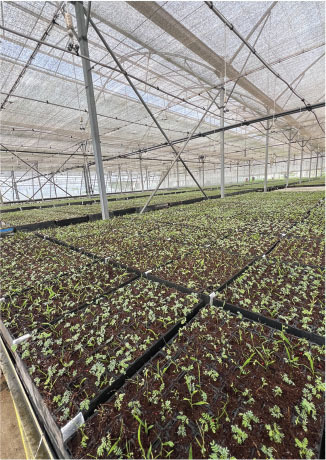
The R&D center at the nursery is dedicated to research on cloning species of both acacia and eucalyptus to obtain maximum yield by using biotech and AI to find and monitor the very best combination of hybrid species. There are some 9,000 ha of land dedicated to R&D on clone types. They are all planted from seed to monitor the best result as they grow to be harvested, usually in four or five years. APP has enlisted Brazilian eucalyptus forestry experts in its efforts to obtain the best yields, and are seeing yield improvements of up to 35 percent by using various clone combinations.
FIRE PREVENTION
Next was a visit to the fire tower and to experience firefighter training in one of APP’s forest concession areas in Sumatra. Fire prevention is of massive importance to the company, and it has invested heavily in dedicated resources and systems, including its Integrated Fire Management Systems (IFM). The company has committed to maintaining fire affected areas of less than 2 percent in its concession areas as well as those of its suppliers.
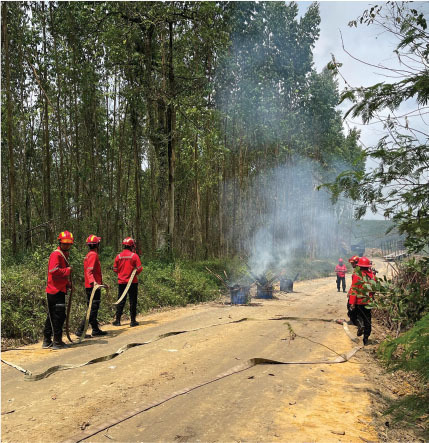
APP has invested more than US $250 million since 2015, and its ongoing resources include 2,697 dedicated firefighters, 221 fire towers, 16 helicopters for water bombing, 92 speedboats and 103 drones. The IFM includes management of prevention of fires, early detection, and rapid response and uses infrared detection cameras and is also trailing satellite technology.
PEOPLE AND COMMUNITIES
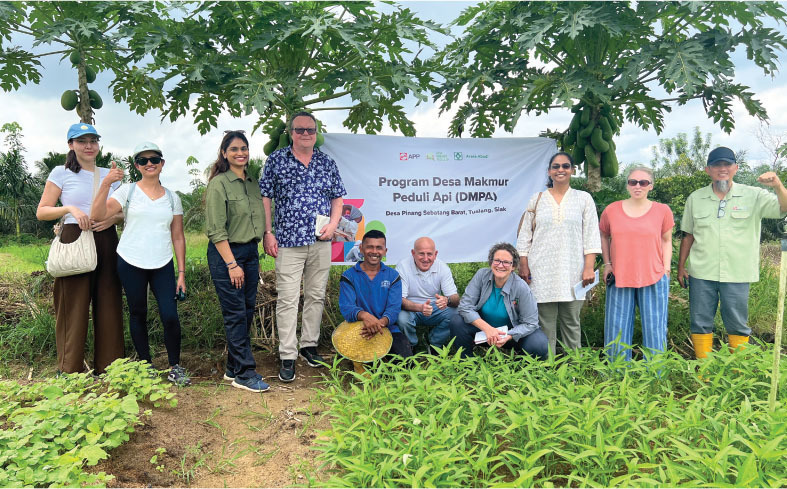
As part of our journey around Sumatra, we visited one of APP’s Desa Makmur Peduli Api (DMPA) programs, a 1.1 ha smallholding which is supported by the company in local areas in and around its concessions. This smallholding allows the farmer to grow produce including melons, green beans, and bananas to sell at local markets. The DMPA assists the farmer by supplying equipment and tools for planting and harvesting as well as advice on marketing and selling products.
Most forest fires in Indonesia start with the local communities clearing land to grow food, or to create an income. In 2015, APP launched the DMPA program, based on the integrated forestry and farming system concept as a means to tackle the issue of forest and land fires. The program aims to lessen the pressure on forest land by providing alternative livelihoods for the communities living in and around forest areas. The program has seen a huge success since its inception, with 441 villages now involved benefiting more than 80,000 local people. The DMPA program is in the process of being expanded to 30 more villages.
ELEPHANT SANCTUARY
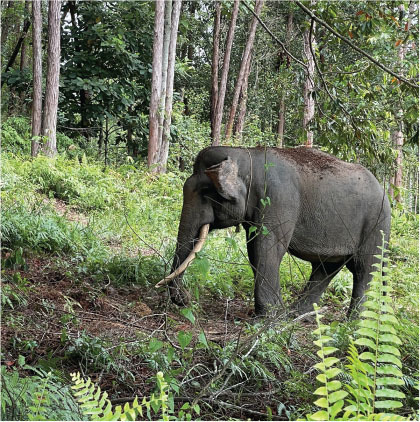
APP has programs for the protection of indigenous wildlife living in and around its concessions, including the Bornean orangutans, Sumatran elephants, and Sumatran tigers. As part of the tour we visited an elephant sanctuary, the Arboretum, where there are six elephants: Nando, Ivo, Libo, Mali, Bonita, and Bubu. Four elephants were originally adopted by the Arboretum and the number has risen to six as two calves have been born over recent years.
To mitigate the human-wildlife contact, APP monitors animal distribution within all its concession areas, including its suppliers maintaining wildlife maps, and natural paths where the animals roam. As part of its program on wildlife and habitat, APP has 296 Sumatran elephants 77 Sumatran tigers and 190 orangutans under its protection.
TISSUE MILL VISIT
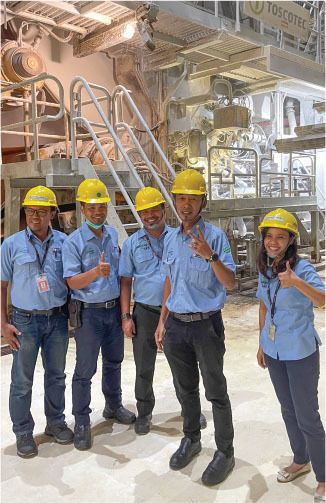
Our final visit on the tour was to APP’s Pindo Deli Perawang tissue mill in Sumatra. The existing overall capacity at the mill is around 650,000 metric tpy; however, this can be raised to 720,000 metric tpy when orders dictate.
The mill has numerous tissue machines in operation with the latest installations being from, A.Celli, Toscotec and China Gold Sun. Products the mill makes include jumbo rolls for export and converting in-house, where it converts to make facial and bathroom tissue, napkins, kitchen towel and hand towel as well as MG (machine glazed) paper. Some 80 percent of the finished products are sent for export.