
February 10, 2026
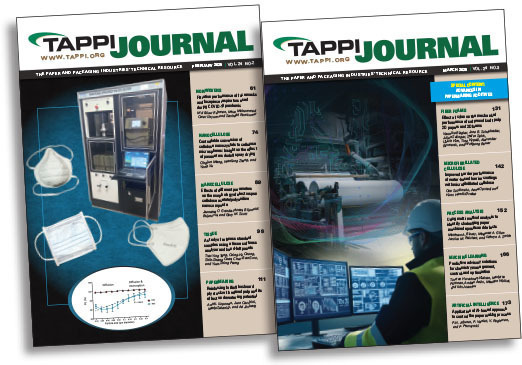
The papers summarized here are from the February issue and the special March issue on Advances in Papermaking Additives. TAPPI Journal is an online open access publication of relevant and timely peerreviewed research. To receive TAPPI Journal, visit tappi.org/subscribe or search the archive of previously published papers at tappi.org/tj. Authors can submit research for publication in TAPPI Journal at tappi.org/tjsubmit. There is no fee to publish and copyright remains with the authors.
FEBRUARY
NONWOVENS
Filtration performance of face masks and facepiece respirators used during COVID-19 pandemic
Md Faizur Rahman, Mirza Mohammad Omar Khyum, and Seshadri Ramkumar
The rapid spread of SARS-CoV-2 has created challenges for societies, healthcare settings, businesses, and institutions. To curb virus transmission, various measures like lockdown, social distancing, hand hygiene, and using appropriate personal protective equipment (PPEs), including face masks, have been recommended. Face masks and facepiece respirators are considered to act as barriers against microbial transmission from person to person.
In this study, researchers selected barrier materials used during the COVID-19 pandemic that included four non-medical face masks and three facepiece respirators. Results showed that facepiece respirator R95 has the highest filtration efficiency (above 99 percent), which remains more or less the same over different particle sizes. The N95 respirator’s filtration efficiency was lower than that of R95, but its barrier resistance was lower than that of the R95, indicating that it can be comfortably used over longer duration. Face masks were evaluated using ASTM F 3502-24 for their barrier performance.
At 0.1 and 0.3 μm particle size, domestically manufactured masks met the standard for higher performance. Interestingly, the results indicate that quality of raw materials and manufacturing standards play important roles, as is evident in domestically manufactured face mask and facepiece respirators, which outperformed imported masks during the COVID-19 pandemic.
NANOCELLULOSE
Controllable conversion of cellulose nanocrystals to cellulose microspheres: Insight on the effect of parameters during spray drying
Qingjun Meng, Wenliang Zheng, and Yang Xu
Cellulose microspheres, which have mainly been produced via the sol-gel method until recently, exhibit a promising potential for broad applications due to their regular microstructure and renewability. However, some issues with production of cellulose microspheres, such as the recycling of involved organic solvents and the removal of the residual solvents, should be solved.
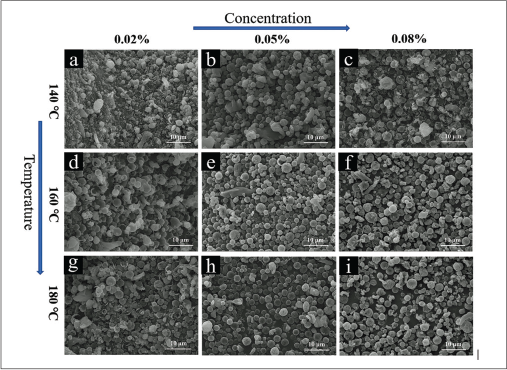
In this study, a cellulose nanocrystals (CNCs) suspension was used to produce cellulose microspheres via spray drying in order to avoid the use of organic solvents. Researchers investigated the effects of CNCs particle size, CNCs concentration, and inlet temperature of spray drying on microstructure and particle size of cellulose microspheres. Results indicated that the optimal average particle size and concentration of CNCs used for obtaining cellulose microspheres were 106 nm and 0.1 wt%, respectively. Generally speaking, converting CNCs to cellulose microspheres via spray drying is beneficial for promoting the controllable and continuous production of cellulose microspheres.
NANOCELLULOSE
Effects of different parameters on the morphology of electrospun cellulose acetate/polyaniline nanocomposite
Jeanette O. Grande-Flores, Biljana M. Bujanovic, and Gary M. Scott
Cellulose is the most abundant naturally occurring polysaccharide. Cellulose derivatives, including cellulose esters such as cellulose acetate (CA), are readily generated in the fiber form following dissolution using a variety of solvents.
Electrospinning is one of the emerging technologies with an outstanding ability to regenerate fibers in the nanoscale range. Polyaniline (PANI) is a conductive polymer that is popular for its high chemical stability, nontoxicity, good processability, and stable intrinsic redox state.
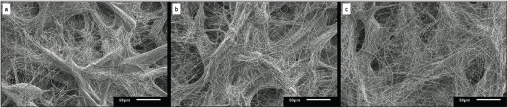
This study explored the fabrication of a conductive PANI/CA nanocomposite through electrospinning. Researchers produced coherent PANI/CA nanofibers, then investigated the effects of varying CA concentration, amount of PANI, molecular weight of CA, and feed flowrate on the morphology of the nanofibers.
This study can be useful to other researchers who are interested in the nanotechnology applications of cellulose. It can also be beneficial for industrial manufacturing engineers who use electrospinning for fabricating conductive nanothreads and similar applications.
MARCH
MICROFIBRILLATED CELLULOSE
Improved barrier performance of water-based barrier coatings with microfibrillated cellulose
Otto Soidinsalo, Anne Opstad, and Hans Henrik Øvrebø
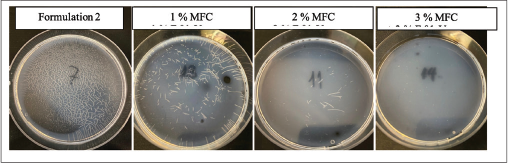
This work explores the impact of microfibrillated cellulose (MFC) on the properties of water-based barrier coatings intended for food packaging. The authors used commercially available MFC for improving the rheology and water retention of three different commercially available dispersion coatings (acrylic, styrene acrylic, and polylactic acid). Coatings were applied by rod to paper, and barrier properties were tested by measuring air permeability and water barrier properties. Results clearly showed that addition of MFC to water-based dispersion coatings improved the barrier performance of the final coatings.
This study shows how MFC can be used to improve barrier performance, applicability, and drying properties of water-based barrier coatings. It is possible to reduce the coat weight and still obtain better barrier performance against grease and water, for example, even on a porous paper. This will have a strong impact on the packaging’s sustainability and raw materials costs and help obtain a plastic:fiber ratio that meets the limits set by regulations.
ARTIFICIAL INTELLIGENCE
Application of AI-based approach to control the papermaking process
P.N. Arjunan, P. Venkat, V. Raghavan, and P. Pruszynski
This study explores the role of artificial intelligence (AI) in revolutionizing the pulp and paper industry, and specifically in predicting wet tensile strength (WTS) for specialty-grade papers. Leveraging eLIXA technology, a 90-day study achieved a 15 percent reduction in chemical dosage and an 80 percent decrease in wet tensile standard deviation. The real-time dosage prediction led to optimizing the wet strength resin (WSR) consumption and improved process reliability. The self-learning models exhibited adaptability to changing variables, ensuring their robustness.
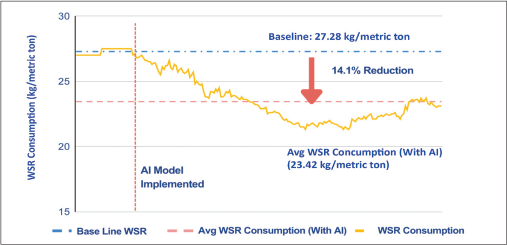
Overall, this study highlights AI’s transformative impact on efficiency, cost savings, and product quality within the dynamic landscape of papermaking. The approach used for wet strength optimization has been used to optimize other aspects of pulp and paper production.
This study will benefit papermakers, process engineers, and mill management professionals through better utilization of available data in predictive process control capabilities. Impacts of the predictive algorithms will benefit production cost, efficiency, and reduction of off-spec product.
Other Research Appearing in TAPPI Journal ‘s February and March Issues
TISSUE (February)
A study of softness standard samples using a tissue softness analyzer and hand-felt panels
Tser-Ying Teng, Ching-Ho Chang, Shih-Sheng Chen, Chao-Ben Gwo, and Yuan-Shing Perng
PAPERMAKING (February)
Reinforcing folding boxboard ply stock with refined pulp and its effect on dewatering potential
Antti I. Koponen, Juan Cecchini, Merja Selenius, and Ari Jäsberg
FIBER FOAMS (March)
Effect of xylan on the mechanical performance of softwood kraft pulp 2D papers and 3D foams
Veronika Biegler, Jana B. Schaubeder, Julian Selinger, Stefan Spirk, Ulrich Hirn, Tiina Nypelö, Alexander Bismarck, and Wolfgang Bauer
MACHINE LEARNING (March)
Predictive advisory solutions for chemistry management, control, and optimization
Torsten Haverinen-Nielsen, Marjatta Piironen, Anders Ånäs, Meagan Walker, and Iiris Joensuu
PROCESS ANALYSIS (March)
Using multi-method analysis to identify challenging paper machine deposits and defects
Matthew A. Blazey, Margaret A. Gillan, Jessica M. Reichert, and Kathryn A. Smith