
September 24, 2025
Title: Compression Wood Identification in Pulpwood
This method is concerned with the detection of the compression wood that can be recognized by unaided vision or by means of a simple viewing device (1). Normally this is sufficient for operating purposes. Microscopic and chemical tests may be required in special cases. Severe and intermediate forms of compression wood are easily recognized, once the observer becomes familiar with their general characteristics. The borderline form requires some practice to distinguish it from normal wood. A viewing box is useful for training an observer and as an aid in deciding doubtful cases.
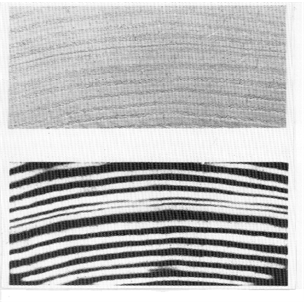
Fig. 4. Cross-section of compression wood in southern yellow pine 4.8 mm (3/16 in.) thick. Top view: photographed in reflected light. Bottom view: photographed by transmitted light. Note the opacity of the latewood.
Purchasing Link: https://imisrise.tappi.org/TAPPI/Products/01/T/0104T267.aspx
Date of Publication: May 29, 2025
If you would like to share your experience with Standards, TIPs or ISO TC 6, please write to standards@tappi.org and the TAPPI Standards team will be happy to interview you.