
May 27, 2026
In the heart of Italy’s renowned “tissue valley” in Lucca, Gambini stands as a testament to family-driven innovation spanning over 150 years. Founded in 1870 as a blacksmith shop crafting tools for agriculture, the company entered the tissue industry in 1989 using its experience in metal work to create its first embosser. Since then Gambini has fully embraced tissue converting and is now one of the technology’s leaders.
After decades of successful innovation, today Gambini is led by the fifth generation of the family, including Executive Board member Gianni Gambini, who heads up the company’s North American base in Green Bay, Wisconsin, a strategic hub mirroring Lucca’s tissue prominence in Europe. Gambini says, “We are proud to say that now Gambini is a global leader in tissue converting machinery, emphasizing not just speed and efficiency, but the quality of the final product that reaches consumers.”
With more than 250 employees worldwide, Gambini operates manufacturing and R&D in Lucca, a customer care and spare parts facility in Green Bay, and its most recent site in Joinville, Brazil, to serve South America’s rapidly growing market. In North America, Gambini supports around 10 customers with nearly 40-50 installed lines, many featuring repeat orders as evidence of satisfaction.

“In North America, where service expectations are high, our Green Bay facility focuses on being a pure customer care site,” says Gambini. “Here we have top experts to make sure our customers have rapid and first-class technical support as well as on-demand spare parts logistics. Since its launch, the Green Bay operation has received excellent customer feedback, and our strategy here is to grow our customer base, as well as support our existing customers in their own future production plans.
“In Brazil, we have just opened a new site for supporting the rapidly growing local market. It is a manufacturing and assembly site as it’s a challenge to import equipment into the country, and it is well positioned to service our customers in the region. We are also planning to eventually expand to serve the rest of South America.”
AN EXTENSIVE, GROWING CONVERTING PORTFOLIO
The company’s portfolio covers both consumer (retail) and Away-from-Home (AfH/professional) segments, offering high-speed converting lines at 600-700 m/min, alongside an upcoming entry-level 500 m/min option. Flagship lines include the quick-delivery Giulia, the customizable Seicento and Settecento (consumer lines), the ProFlex series (AfH) and the top-tier G1, “All our converting lines are known for their reliability and premium quality,” says Gambini.
A standout of its innovation is the TouchMax embosser-laminator, introduced around 2013, with over 100 units sold globally. It enables quick, safe pattern changes in minutes, simplifying operations and enhancing product variety, for example, from bathroom tissue to kitchen towels.
“At the moment, we are supplying mid to top tier converting lines. However, on retail lines we will soon be launching an entry level line, 500 m/min option, the Giulietta, which still delivers the highest quality. This now widens our portfolio from entry level to the very largest tissue mill customers,” says Gambini.
AIRMILL—A REVOLUTION IN CONVERTING TECHNOLOGY
The latest tissue market trends analyzed by Gambini have found a push for uniqueness amid competition, combining premium attributes (softness, absorbency, strength, and bulk) with sustainability, using fewer resources for better results.

Another trend is the requirement for simplicity of operation, a key-point for its value deployment strategy. Gambini stresses, “Amid skilled labor shortages, lines must be intuitive, avoiding over-automation that demands engineers for troubleshooting. Flexibility for quick format changes remains key across the industry.”
A prime example of one of Gambini’s latest innovations to fulfill customers’ ambitions is AirMill, the revolutionary wet embossing technology introduced in 2017 and now with nearly 50 installations worldwide. Described as bringing a “piece of the paper mill into converting,” AirMill applies controlled moisture to the sheet before heated steel-on-rubber embossing. This breaks and reforms hydrogen bonds gently, plasticizing the sheet without degrading strength, unlike traditional dry embossing.
Key benefits of AirMill technology include retaining or increasing tensile strength while boosting bulk, thickness, absorbency, and texture. It enables “impossible” deep patterns that would destroy dry sheets, producing products comparable to structured or TAD tissue, but using conventional base sheets. There are major benefits to the AirMill technology. Energy comparisons highlight its sustainability (see Figure 1): conventional processes at 100 units, TAD at 225, hybrids around 140, but AirMill-integrated lines at just 109, yielding superior products with far lower consumption and CO2 emissions in the integrated process, empowering new investments.
Integrated with papermaking, AirMill allows mills to reduce fibers, refine less, and adjust pulp mixes, cutting costs while elevating quality. Installation is straightforward: a compact unit fits between unwinders and embosser-laminator on existing lines, boosting productivity without complexity.
“Our customers are looking for two critical elements in their tissue operations going forward: the ability to create unique, high-quality products, together with excellent sustainability performance; and improved OEE,” says Gambini. “This is where our R&D focus lies. For us, it is not just about introducing digitalization and AI, it is about the basics of simplicity and machine performance, making it easier for the operator while at the same time creating products that stand out on the shelves. AirMill technology enables these critical elements to happen.”
ONWARD, UPWARD AND
MORE SUSTAINABLE
Looking ahead, Gambini hints of further breakthroughs, including “an exciting patent-pending innovation set to once again transform converting processes.” The company will also introduce enhanced coreless solutions and a fully automatic backstand with floor-level loading using AGVs for safer, non-stop reel changes, vital for bulky TAD. This, together with superior embossing and rewinding quality, ensures a new operational standard for TAD converting lines. On digital fronts, cautious integration of AI and data platforms is in the works, ones which prioritize privacy, security, and genuine value, starting with proactive maintenance.
Gambini concludes: “Our mantra is ‘finished product first.’ By empowering customers to produce superior, sustainable tissue that enhances consumer well-being and satisfaction, the company positions itself not merely as an OEM, but as a partner in elevating everyday experiences. With all our converting offerings we lead the charge toward more accessible premium quality, and Gambini continues its legacy of agile adaptation, proving that even in a mature industry, revolutionary change is possible.”
The TissueHub
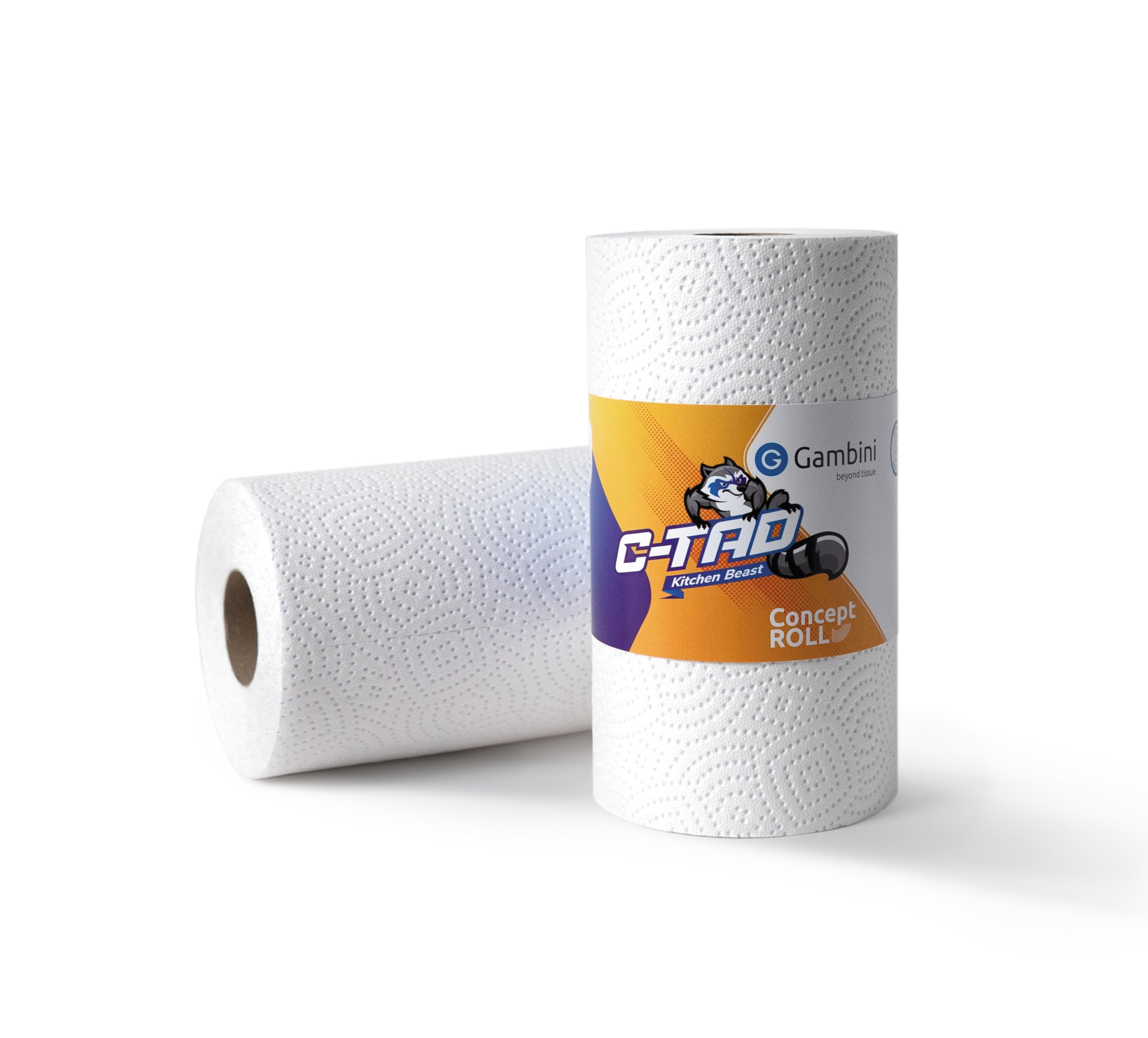
The company’s strategy shifted profoundly in 2018 with the launch of the TissueHub in Lucca: a renovated historic building housing a full-scale integrated pilot converting line, equipped with the latest technologies by Gambini, including AirMill and a G1 (rewinder). Here, a dedicated team of converting and product development experts collaborate with customers to test innovations, develop embossing patterns via the PatternLab, and produce realistic parent concept rolls. This facility allows Gambini to prioritize the finished product, helping clients create unique, market-differentiating items while optimizing sustainability.
“We have very enthusiastic people across the whole of Gambini who keep a close eye on all the tissue products on supermarket shelves.” says Gambini. “Thanks to the TissueHub, we are able to fulfill our mission to understand more about the finished product, enabling us to innovate and empower our customers to make new products to help expand their offerings to the market.”
A good example of innovation from TissueHub is “Kitchen Beast,” Gambini’s own prototype, a three-ply towel exaggerating strength gains and comparable TAD (C-TAD) variants demonstrating AirMill’s versatility.