
February 10, 2026

The papers summarized here are from the April and May issue of TAPPI Journal. TAPPI Journal is an online open access publication of relevant and timely peer-reviewed research. To receive TAPPI Journal, visit tappi.org/subscribe or search the archive of previously published papers at tappi.org/tj. Authors can submit research for publication in TAPPI Journal at tappi.org/tjsubmit. There is no fee to publish and copyright remains with the authors.
APRIL
PULPING
Numerical analysis of the impact of rotor and screen hole plate design on the performance of a vertical pulper
Marcus Britz, Bettina Grashof, Axel Gommel, Gert Gottschalk, Oliver Luedtke, and Wolfgang Mueller
The dissolving of mechanical pulp is one of the most important process steps in stock preparation, since pulping occurs at the very beginning of the papermaking process. Efficient mixing of the pulp in a short amount of time is essential to achieve high furnish volume flow rates. The design of the rotor, as well as the pulper vat and inserts, significantly affects the overall performance of the pulper, such as mixing efficiency and power demand.
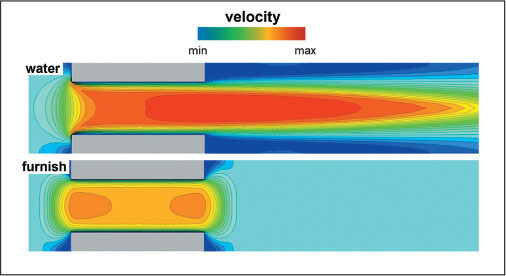
Using advanced numerical methods such as computational fluid dynamics (CFD) can accelerate the development process. The CFD simulations allow for detailed analysis of flow phenomena, making it possible to numerically study a real-size machine.
In this study, researchers compared two different rotor designs used in a vertical pulper and evaluated the numerical results with experimental data. Rotor A is designed for low turbulence and low power demand, while rotor B is designed for high turbulence with high power demand. The CFD results showed good agreement with the experimental measurements. The researchers investigated how the rotor design influences the free fluid surface and the mixing efficiency. This study also highlights the differences in results depending on whether water or furnish is simulated, which exhibit Newtonian or, respectively, non-Newtonian fluid behavior.
A CFD simulation is a state-of-the-art, powerful numerical tool to get a better understanding of the complex flow phenomena that occur within the pulp mixing process. In addition, the development of new pulper products is faster and more cost-efficient.
RECYCLING
Optimizing OCC refining with defloccing
Dwight Anderson
Subjecting pulp to a high shear zone immediately after refining results in more efficient refining. This phenomenon was originally observed to benefit softwood pulp refining. It was attributed to floc reduction based on floc measurements in mill refiners and the observation of reduced headbox plugging. Hence, this phenomenon has been termed “defloccing.”
The present work shows this technology also benefits refining of North American old corrugated containers (OCC). The combined results of several mill trials with OCC defloccing demonstrate the interactions between OCC refining intensity, defloccing technology, and other state-of-the-art refining improvements. At the same refining intensity, defloccing OCC on 100 percent recycled machines increases OCC refining efficiency by 15 percent, with greater efficiency improvement on machines that use softwood as well as OCC. Furthermore, it is shown that the benefits of defloccing are additive to refining improvements made in the refining zone of a refiner plate. Most OCC refiner plate designs can therefore benefit from the addition of a defloccing feature, as it does for softwood pulp.
PAPERMAKING
Study on the effect of aluminum diethyl phosphinate in synergy with ammonium polyphosphate on the flame retardancy of cellulose paper
Zhangyi Wang, Kexin Liu, Ling Xu, Feng Zhu, and Xinxing Xia
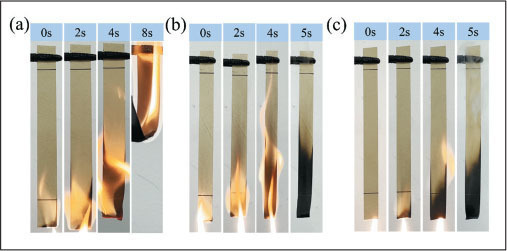
This paper involved the synergistic incorporation of ammonium polyphosphate (APP) and diethyl aluminum phosphinate (AlPi) as flame-retardant fillers for producing flame-retardant paper. The research revealed that APPs were square particles with a smooth surface, and their solubility was 0.29 g/100 mL at 20°C, which increased to 4.12 g/100 mL at 60°C. The surfaces of AlPis were rough and irregular. The solubility of AlPi was 0.023 g/100 mL at 20°C, and the solubility remained stable when the temperature increased. The addition of AlPi had a minor influence on the pulp beating degree. The tensile strength of kraft/APP/AlPi decreased with the increase of the AlPi addition.
Scanning electron microscopy (SEM) showed that the char residue of the kraft/APP/AlPi had a more complete fiber network structure than that of kraft/APP. The Raman spectroscopy indicated that the area ratio of the D (amorphous phase; disordered graphite vibration) band to the G (crystal phase; graphite carbon vibration) band (ID/IG) ratio of kraft/APP/AlPi was lower than that of kraft/APP, meaning that the graphitization degree of the char residue of kraft/APP/AlPi was higher than that of kraft/APP, which indicated the kraft/APP/AlPi had better flame retardancy.
MAY
PAPERMAKING
Pilot-made, highly extensible paper for dry 3D forming
Jarmo Kouko and Tuomo Hjelt
Cellulose fiber-based packaging materials must perform well in demanding three dimensional (3D) forming process conditions. In addition, the development of manufacturing concepts is required for improved competitiveness of bio-based materials. This study covers some key factors that influence the extensibility of cellulose fiber-based structures and presents a pilot-scale development study of a 3D formable material concept.
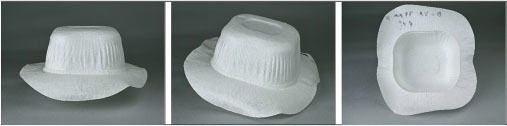
Bleached softwood kraft (BSK) pulp from a Nordic pulp mill was used in the pilot trials. Cellulose-based webs were formed using water-laid and foam-laid web forming using a pilot paper machine. For the water-laid forming, the BSK pulp was refined by applying a high consistency (HC) phase at over 40 percent consistency, followed by a low consistency (LC) refining at 4 percent consistency. The BSK pulp was refined for the foam-laid forming by only applying low-consistency refining. In the foam-laid web forming, anionic sodium dodecyl sulfate (SDS), two foamable latexes, and polyvinyl alcohol (PVA) were used as foaming agents.
The results indicated that the shrinkage that occurred by drying and in-plane compaction depended on the pulp furnish. The water-laid material achieved about 30 percent elongation, whereas the foam-laid material achieved significantly above 50 percent elongation.
Understanding the roles of web-forming methods, chemical additives, shrinkage, elongation, and strength is highly significant for developing new cellulose-based packaging products, particularly those intended for dry web 3D forming. A large improvement in dry web 3D forming performance of paper products can be reached only by applying in-plane compaction and optimal strengthening, as demonstrated in this investigation.
ADDITIVES
Colloidal silica and its effects during formation of paper sheets in the presence of nanofibrillated cellulose, cationic starch, and cationic acrylamide copolymer
Varun S. Atree, Kensley V. Hamm, Daniel J. Kozel, Lucy A. Jones, Jenny Chen, and Martin A. Hubbe
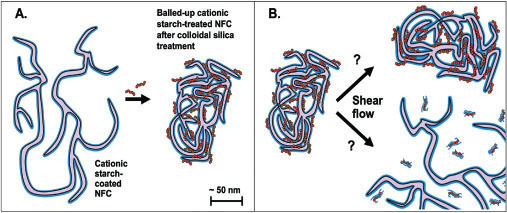
This work considered effects of colloidal silica addition during laboratory preparation of paper sheets containing nanofibrillated cellulose (NFC) that had been pretreated with cationic starch. The emphasis was on process performance issues, including dewatering rates, fine particle retention, and the extent of fiber flocculation. In addition, micrographs were obtained to show what was happening to the NFC upon treatments with cationic starch and subsequent application of hydrodynamic shear.
Researchers obtained contrasting results depending on the charge density of the cationic starch. Pretreatment of the NFC with a high charge density cationic starch (degree of substitution 0.2) resulted in strong interactions with the colloidal silica, enhancing the dewatering rate and contributing to fine-particle retention. The medium charge cationic starch pretreatment led to effects suggesting a bridging mechanism of action, and subsequent colloidal silica had no significant effect on dewatering. Treatment of that system with a high level of colloidal silica (0.2%) resulted in lower retention.
In general, the final colloidal silica treatments tended to decrease the level of flocculation in the suspensions, giving more uniform handsheets. Mechanisms, some of them related to the clustering and dispersion of cationic starch-treated NFC, were proposed to account for the observed effects.
It is well known that colloidal silica can be used in combination with some cationic polymers to enhance dewatering and achieve higher papermaking production rates. Nanofibrillated cellulose is known to slow down drainage rates. This work explored the ways in which subsequent treatment with colloidal silica can sometimes overcome the slow dewatering.
Other Research Appearing in TAPPI Journal’s April and May Issues
PAPERMAKING (April)
Dynamic compression characteristics of fiber-reinforced shoe press belts
Patrick Wegele and L. Daniel SöderbergADDITIVES (May)
Paper strength factors in systems with nanofibrillated cellulose, cationic starch, colloidal silica, cationic acrylamide copolymer, and hydrodynamic shear
Daniel J. Kozel, Lucy A. Jones, Varun S. Atree, Kensley V. Hamm, and Martin A. HubbePAPERMAKING (May)
Research on an energy model for X-ray measurement of paper ash content using COMSOL
Lianhua Hu and Wenbo Chen