
March 3, 2023
As energy costs continue rising at unprecedented rates, reducing energy consumption in mills is more important than ever. More than 70 percent of total energy consumption in tissue machines is consumed in the drying process. Various techniques and tools are now available to help mills optimize their Yankee Hood drying systems and can help provide significant savings.
Alfred Sarli of Valmet will share insight on how a mill can save 10-to-20 percent in energy costs by automating the drying process during his presentation Energy Optimization of the Yankee Hood Air System, on Tuesday, April 25 at TAPPICon 2023 (tappicon.org), April 22—26, in Atlanta, Ga.
“Yankee Hood drying is based on the principle of convective heat transfer in that it depends on both temperature and velocity. Accordingly, total drying costs depend on both the costs of gas and electricity,” Sarli said. “The optimal operating point can be different for every grade and every regional energy cost. Trying to balance this manually is time consuming and requires numerous measurements. The ideal solution is to completely automate the process.”
Attendees will learn more about the Yankee drying process and also hear about the control systems and equipment used in various case studies highlighted during Sarli’s presentation.
TAPPICON 2023—TISSUE TRACK
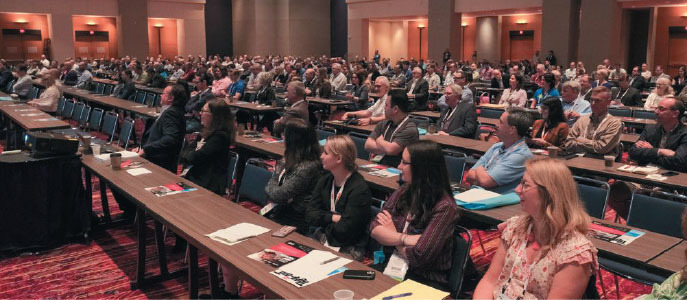
TAPPICon offers tissue professionals from across the supply chain the opportunity to meet and discuss issues, new advancements/technologies, and strategies for future success. The conference includes a peer-reviewed tissue program featuring a mix of technical content and business insights.
The 2023 tissue program, held Tuesday and Wednesday, April 25 and 26, includes expert-led presentations focused on critical areas of the mill. Sessions include energy, fibers, chemistry and vibration.
ENERGY
In addition to Sarli’s presentation, the energy session explores other key areas to help mills become more energy efficient. Mehail Shekhter, Valmet North America, is scheduled to present “How Can Cogeneration Benefit a Tissue Mill.” Attendees will learn about cogeneration, or combined heat and power (CHP), and its benefits. Shekhter will also explore various CHP types and how CHP can reduce mill energy costs and greenhouse gas emissions.
David Barnard from Industrial Shredders will present “Automating Tissue Waste: The Last Frontier,” which explores various benefits and opportunities of automating the waste removal process. Barnard will share details on how mills can achieve automation, as well as how to minimize safety risks, costs involved, and estimated returns. Attendees will also have the opportunity to hear from Brian Mock, Event Capture Systems, as he shares a case study on “Increasing the Paired Efficiency of Tissue Machine and Converting with Machine Vision.”
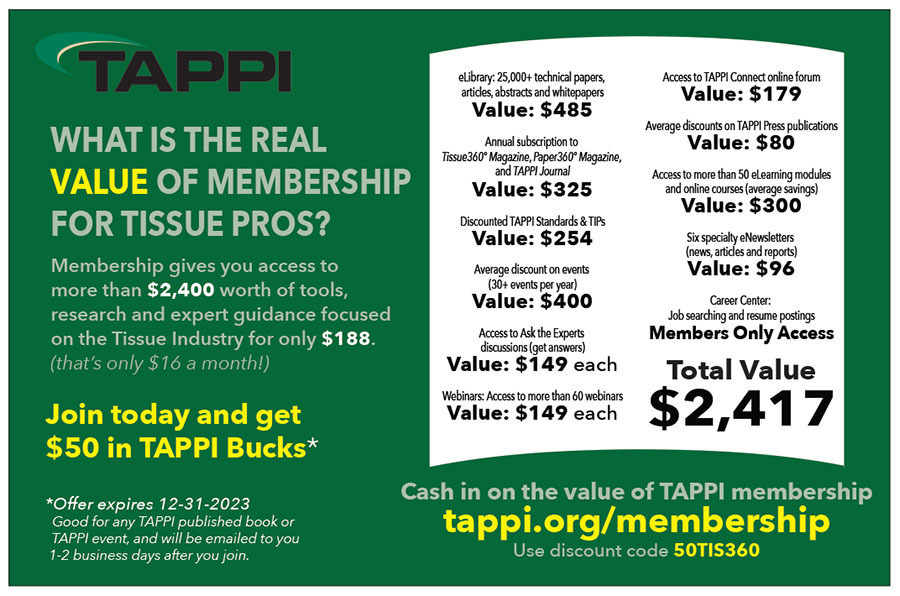
WHAT IS THE REAL VALUE OF MEMBERSHIP FOR TISSUE PROS?
Membership gives you access to more than $2,400 worth of tools, research and expert guidance focused on the Tissue Industry for only $188.(that’s only $16 a month!)
Join today and get $50 in TAPPI Bucks∗
∗Offer expires 12-31-2023 Good for any TAPPI published book or TAPPI event, and will be emailed to you1-2 business days after you join.
eLibrary: 25,000+ technical papers, articles, abstracts and whitepapers Value: $485
Annual subscription to Tissue360º Magazine, Paper360º Magazine, and TAPPI Journal
Value: $325
Discounted TAPPI Standards & TIPs
Value: $254
Average discount on events (30+ events per year)
Value: $400
Access to Ask the Experts discussions (get answers)
Value: $149 each
Webinars: Access to more than 60 webinars
Value: $149 each
Access to TAPPI Connect online forum
Value: $179
Average discounts on TAPPI Press publications
Value: $80
Access to more than 50 eLearning modulesand online courses (average savings)
Value: $300
Six specialty eNewsletters (news, articles and reports)
Value: $96
Career Center: Job searching and resume postings
Members Only Access
Total Value $2, 417
Cash in on the value of TAPPI membership tappi.org/membershipUse discount code 50TIS360
FIBERS
Demand for recycled fibers in tissue-making has increased steadily worldwide. This critical resource is the focus of the fibers session at TAPPICon. Attendees will hear from Mrittika Debnath of North Carolina State University as she presents, “Innovating Recycled Fibers Using High-Shear Homogenization for Sustainable Packaging and Hygiene Bioproducts.” Debnath will discuss an alternative approach to old corrugated containers’ (OCC) pulp fibers modification that will enhance fiber and paper properties, such as mechanical strength, without affecting dewatering. Attendees will also learn about a novel approach to circumvent the challenges associated with traditional methods of developing strength properties from OCC, mixed waste, and nonwood fibers as David Zerr of Pulmac Systems International presents “Developing Strength from Recycled Fibers using Micro Fibrillation.” Attendees will hear from Bob Bustin of Oasis Alignment as he presents “Inspection Data is Critical to Planning Dryer Can Adjustments to Solve Wrinkling and Vibration Issues.”
CHEMISTRY
Based on the use of various chemicals and functional additives in the tissue making process, a wide variety of tailor-made properties can be built into the sheet to improve and optimize it. New innovations and process advancements can pave the way to more product opportunities. Attendees at the Chemistry session will hear about a new high-performance Yankee coating adhesive for TAD and hybrid-TAD tissue and towel machines. During his presentation “New Simplified High-Performance Yankee Coating for Advanced Machine,” Jia-Yu Wang of Nalco Water, an Ecolab Company, will share how a new single, high-performance adhesive produces super adhesion from a soft, durable film that has improved film uniformity and thickness.
Polyamidoamine epichlorohydrin (PAE) resins have been a predominant chemistry used for generating wet strength in towel grades for more than 50 years, but there are several downsides to their use, including increased regulatory scrutiny due to harmful chloro-organic byproducts present in the resin. Lucyna Pawlowska of Kemira will share insight on a more effective and cleaner alternative to PAE resins during her presentation, “Wet Strength Alternative for Towel Grades.” Attendees get details on how this alternative, glyoxalated polyacrylamide (GPAM) resin provides wet strength permanency close to that achieved with PAE resins, as well as dry strength, improved repulpability, and no chloro-organic impurities.
VIBRATION
While vibration monitoring systems that monitor the tissue creping process have been around for over 10 years, recently it has been realized that vibration monitoring can provide additional insight into the overall creping unit operation. It is a valuable tool for the tissue maker to understand and track in real-time the impacts of mechanical, operational, and chemical (MOC) changes to the creping operation. Gary Furman of Nalco Water, an Ecolab Company, will share details about a new digital tool called Yankee Operations Intelligence used for monitoring and providing unique insights into the creping process during his presentation “Introducing Yankee Operation Intelligence—A Next Generation Crepe Blade Vibration Monitoring Tool.”
Vibration monitoring is also important for maintenance and reliability engineers to identify mechanical problems early, keeping machines running and plants operational. Successful condition monitoring depends on field-proven vibration monitoring best practices. Mills can learn about these best practices during Tom LaRocque’s, Wilcoxon Sensing Technologies, presentation “Best Practices: Vibration Monitoring of Pulp & Paper Production Assets.”
THERE’S MORE…
In addition to these presentations, attendees can gain a greater understanding of the surface modification of lignocellulosic fibers to reduce hard-to-remove water and its effect on the properties of tissue and hygiene products. Hasan Jameel of North Carolina State University (NCSU) will present “Sustainable Surface Modification Strategies for Upgrading Softness and Tensile Properties of Lignocellulosic Fibers.” They can hear Lokendra Pal, also of NCSU, share the results of a study on sustainable alternative fibers that show better exhaustion than commercial wipes and textile fibers during his presentation “Understanding of Quat Binding with Cellulosic Fibers and Wipes for Sustainable Hygiene Product Developments.”
TAPPICON 2023
With the theme Three Rings of Success: Vision • Technology • Action, TAPPICon 2023 is designed to help mills identify technology solutions and strategies to stay competitive into the future. In addition to tissue, TAPPICon addresses critical topics affecting paper, recycled paperboard, and reliability and maintenance, as well as topics affecting women in industry and young professionals.
For questions about TAPPICon 2023 or to register, please visit TAPPICon.org. Mills receive a special discount when they register their teams. For more information about the Tissue Track, contact Tissue Division Manager Hannah Peterson at hpeterson@tappi.org, or by phone at 770-209-7243.